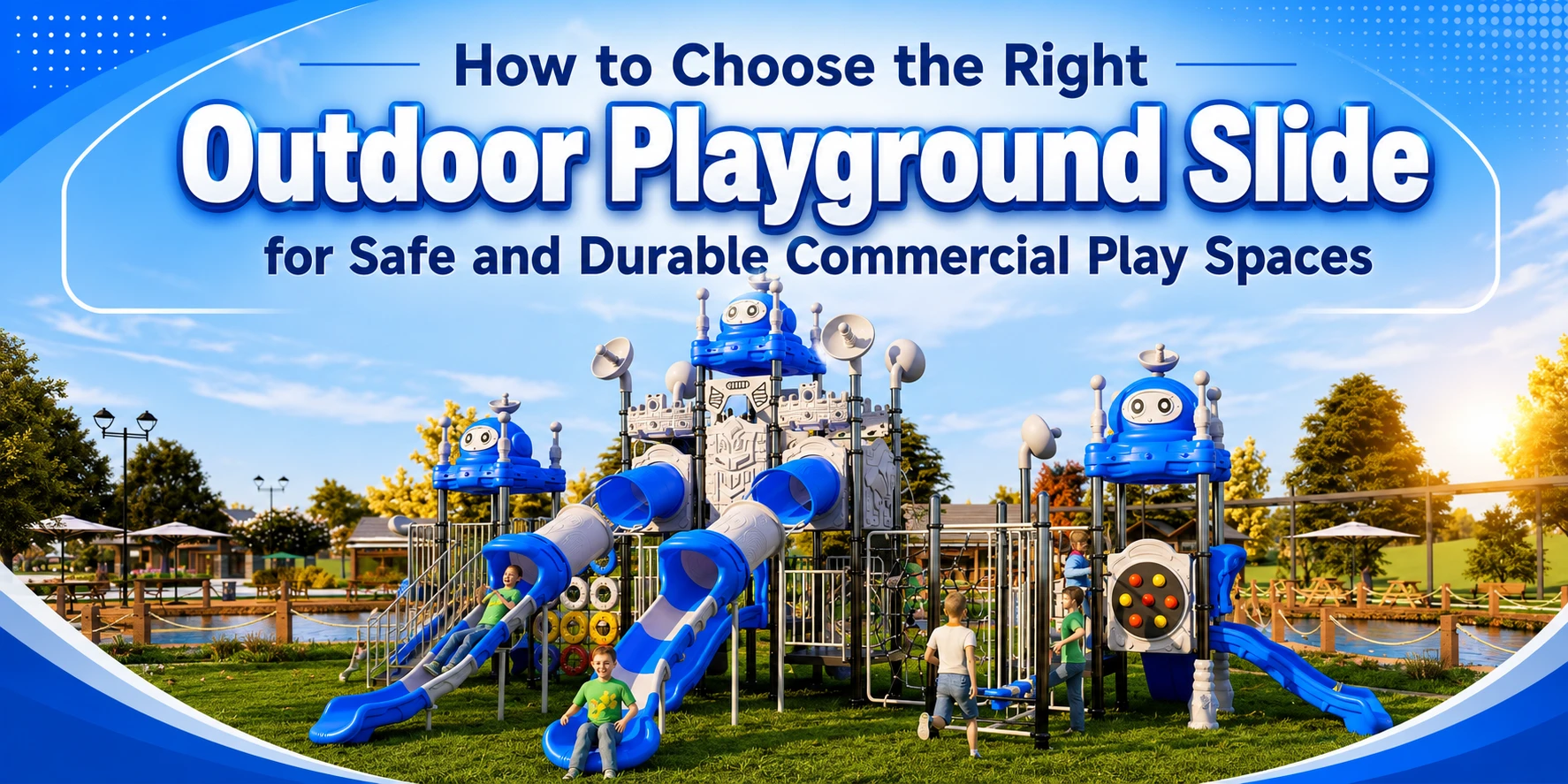
Selecting the right outdoor playground slide for a school playground or public park involves more than choosing a colour. With an estimated 200,000 playground-related injuries treated annually in the US alone, the commercial slide you specify directly affects user safety and equipment lifespan.
An outdoor playground slide is a structural play component designed for controlled descent. For commercial use, it must meet specific height, slope, and material requirements defined by standards such as ASTM F1487 and EN 1176. These standards govern everything from minimum platform heights to impact attenuation zones, ensuring the slide functions safely under repeated daily use.
JQ Playground, an experienced manufacturer with over 30 years in the industry, offers a wide range of outdoor playground slides that comply with these standards. Their expertise in custom design and large-scale production makes them a reliable partner for schools, parks, and commercial play spaces.
Whether you work with a kids playground supplier or evaluate equipment independently, the following sections cover the main slide types, age-specific selection criteria, material comparisons, and installation requirements. Each factor influences long‑term durability and compliance, helping you make an informed, project‑appropriate choice.
Types of Outdoor Playground Slides for Commercial Use
When working with a kids playground equipment supplier, you’ll encounter five main slide designs. Each type affects space requirements, user capacity, and safety certification compliance. Below are the commercial variations with typical dimensions and slope ranges.
-
Straight slides — the most common type. Bed lengths range from 2.4 m (toddler) to 3.7 m (school-age). Slope between 25–35 degrees. ASTM F1487 and EN1176 require a minimum bed width of 300 mm for single-child use and a guardrail height of at least 100 mm for slides over 1.5 m high.
-
Wave slides — feature two to three undulations that slow descent slightly. Typical length 3–4.5 m. Slope at entry steeper (30 degrees) then shallows to 15–20 degrees. Manufacturer’s instructions must specify the maximum fall height, often 2.5–3.0 m.
-
Spiral slides — one or more full 360° turns. Minimum internal radius of 1.2 m (EN1176: 1.5 m recommended). Entry height can reach 3.7 m. Capacity is limited to one child; turn radius and slope must be verified with the manufacturer’s load test data.
-
Tube slides — fully enclosed, often made from roto-moulded HDPE with a minimum tube diameter of 560 mm (700 mm for wheelchair-accessible versions). Straight tube slides are 2.5–3 m; spiral tube slides can be 4–5 m long. EN1176 requires a gap of at least 120 mm between the widest part of a seated child and the tube wall.
-
Parallel or double slides — two separate sliding lanes side by side, typically 1.5–2 m apart. Each lane meets the same dimensions as a single straight or wave slide. Used for social play but does not double capacity; each lane still supports one user at a time.
A school playground supplier will often specify slide height according to age‑group — toddlers need slides under 1.2 m, while school‑age units can reach 2.4 m. Always check that the chosen model’s dimensions and slope comply with the standards applying in your region.
Age-Specific Slide Selection Guidelines for Schools and Parks
Selecting a slide for a school or park begins with matching the age group to the correct height, slope, and surfacing. Standards such as ASTM F1487 and EN 1176:2017 prescribe distinct parameters for toddlers, preschool, and school‑age children. The table below summarises the key specifications.
| Age Group | Slide Height (max) | Slope Angle (typical) | Recommended Safety Surfacing | Standard Reference |
|---|---|---|---|---|
| Toddlers (6–23 months) | 1.2 m | 30 degrees or less | 1.8 m fall‑height zone of rubber mulch or poured‑in‑place rubber | EN 1176:2017 Part 10 |
| Preschool (2–5 years) | 1.8 m | 30–35 degrees | 2.4 m fall‑height zone of engineered wood fibre or synthetic tiles | ASTM F1487‑21 (age 2–5) |
| School‑age (5–12 years) | 2.4 m | 35–40 degrees | 3.0 m fall‑height zone of loose‑fill rubber or bonded rubber | EN 1176:2017 Part 1 & ASTM F1292 |
Inclusive design is equally critical. A kindergarten playground supplier should ensure slides include transfer platforms, wider chutes (at least 30 cm), and gentle transitions to accommodate children using mobility aids. Community playground suppliers often specify these features to meet accessibility guidelines such as the UK Equality Act or ADA equivalent. Within each age band, you must also verify that the slide exit height leaves at least 75 cm of clear space and that the landing area extends beyond the slide’s projected path.
Comparing Slide Materials: HDPE vs. Metal for Durability and Safety
The material you choose directly affects lifespan, maintenance frequency, and real-world safety performance. HDPE (rotomolded polyethylene), stainless steel, and galvanized steel each respond differently to sun, impact, and daily use across commercial playgrounds and indoor play centres.
UV resistance and surface temperature. HDPE contains UV stabilisers that prevent fading and surface brittleness for 10–15 years in outdoor installations. Metal slides, especially galvanized steel, can reach surface temperatures above 60°C in direct sunlight, causing burn-risk complaints on hot days. Stainless steel reflects more heat than galvanized but still conducts temperature rapidly to the touch.
Impact strength and dent behaviour. HDPE absorbs repeated impacts without permanent deformation, making it suitable for high-traffic school and park settings. Galvanized steel dents under concentrated loads, and those dents create sharp edges over time. Stainless steel resists denting better but adds 30–40% to the material cost.
Maintenance intervals. HDPE needs only washing with mild soap and water. Galvanized steel requires annual inspection for rust spots and touch-up painting — more frequently in coastal or humid regions. Stainless steel resists corrosion but can develop surface pitting in salt-air environments, so rinse schedules still apply.
Slip resistance. Textured HDPE retains grip when wet or dirty. Metal surfaces become slick in rain, condensation, or after cleaning unless specified with a raised-grip finish during manufacturing.
For commercial installations, HDPE slides typically deliver 12–15 years of service with minimal upkeep. Metal slides average 8–12 years before corrosion, denting, or surface wear requires replacement. When sourcing from a mall kids playground supplier or kids indoor playground supplier, specify the material grade and UV stabilisation rating rather than relying on generic product descriptions alone.
Installation, Safety Surfacing, and Maintenance Requirements
Proper installation begins with stable anchoring. Follow these steps:
- Excavate and pour concrete footings at least 600 mm deep unless the manufacturer specifies deeper requirements for heavy loads.
- Set the slide platform posts into wet concrete, ensuring plumb alignment and a minimum embedment depth of 400 mm.
- Allow concrete to cure for 72 hours before attaching the slide bed and any safety barriers.
- Backfill the area with compacted soil or gravel to prevent erosion around the base.
Fall height zones must comply with CPSC guidelines: a minimum fall zone of 1.8 m around the slide exit and 1.2 m on each side. For slides over 1.2 m high, the surfacing depth must absorb an equivalent critical fall height. Three surface options meet ASTM F1292 requirements:
- Engineered wood fibre – 225–300 mm loose depth suitable for fall heights up to 3 m.
- Poured-in-place rubber – 50–100 mm bonded layer, low maintenance but higher initial cost.
- Rubber mulch – 150–300 mm depth, good drainage but needs regular top-ups.
Inspect daily for debris, exposed hardware, or surface depressions near the slide exit. Monthly checks should include fastener torque, surface compression, and edge wear. Schedule a full annual audit by a certified specialist to assess structural integrity and sliding surface friction. Common wear areas include the ladder treads, platform joints, and the landing zone surfacing – replacements here maintain compliance for any safe kids playground equipment you specify.
When sourcing components through a kids outdoor playground supplier, always request certified installation manuals and surfacing depth charts for your specific slide model. Manufacturers like JQ Playground provide trial installation before shipping and offer one-year quality warranty, ensuring your investment is protected.
About JQ Playground – kidsplaygroundsupplier.com
JQ Playground (Wenzhou Jiqi Amusement Equipment Co., Ltd.) is a children’s playground equipment manufacturer founded in 1993. The company provides design, customization, large-scale manufacturing, sales, installation guidance, and after-sales support for outdoor playgrounds, indoor playgrounds, soft play, water playgrounds, PE board playgrounds, kindergarten furniture, outdoor fitness equipment, pet playgrounds, and playground facilities. Approved company facts include 180+ employees, a large Wenzhou production base, 20+ production lines, 55 production machines, ISO/BSCI/EN1176/EN71/ASTM/CPC/CPSIC certification references, 100+ patents, free design support, OEM/ODM capability, trial installation before shipping, export experience, and one-year quality warranty.