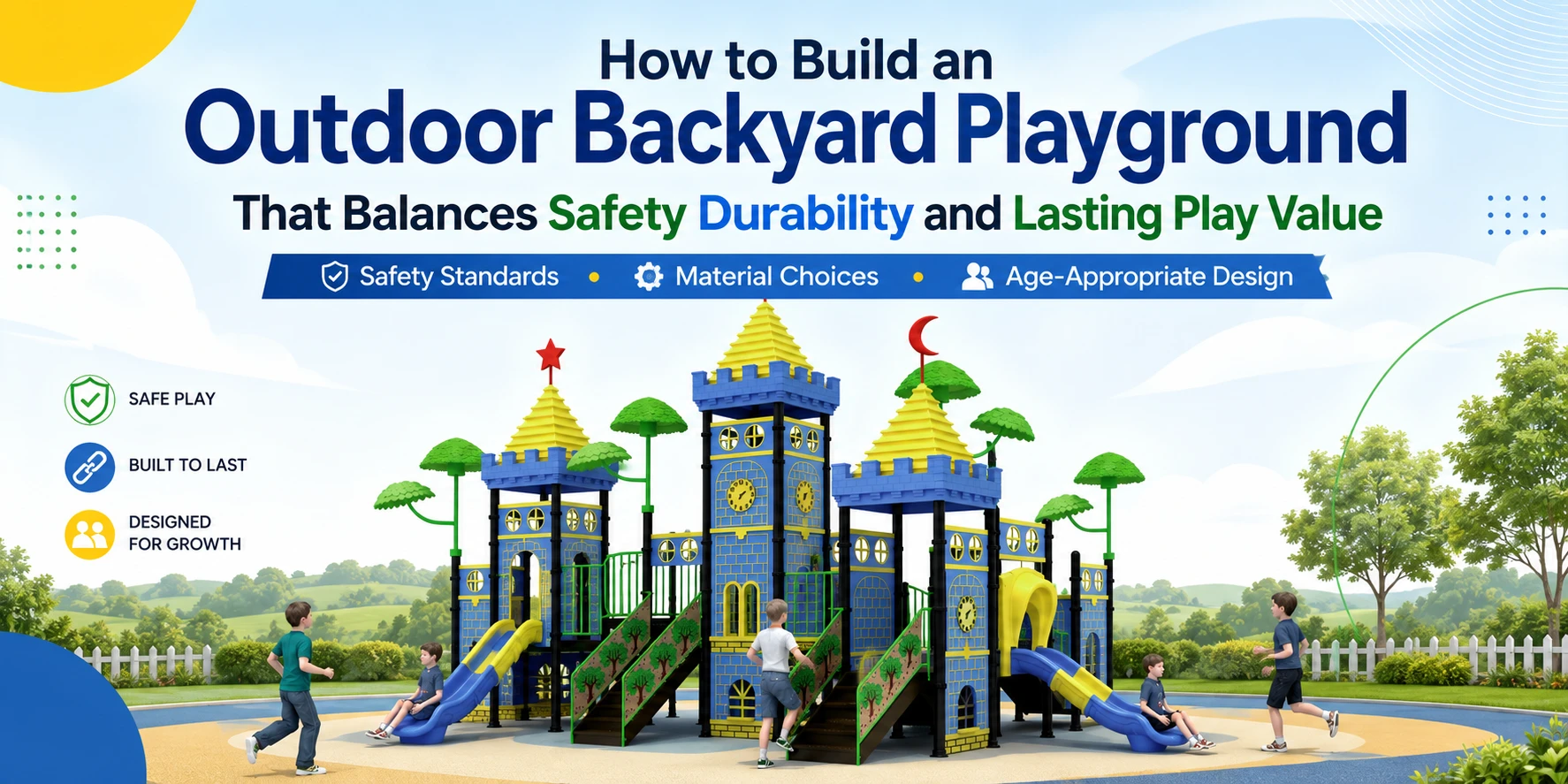
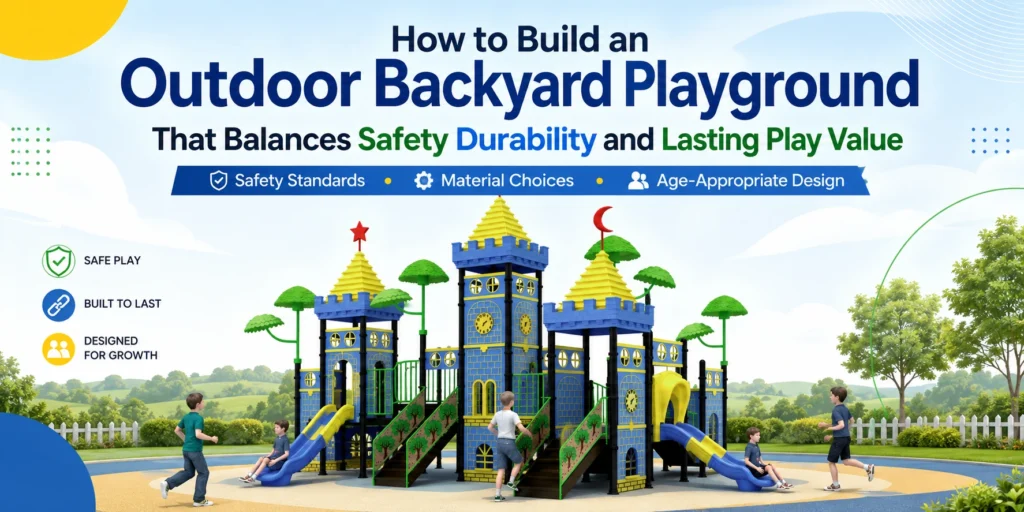
You need a play space that keeps children active, safe, and entertained for years. Backyard equipment often fails to withstand heavy use, weather, or safety inspections. Finding a solution that balances cost, compliance, and long-term durability is the core challenge for school buyers, community operators, and park owners.
An outdoor backyard playground is a purpose-built play area using commercial-grade equipment designed for frequent, supervised use. It includes structures like slides, swings, and climbers built to ASTM or EN standards, with UV-resistant materials and deep anchoring. Unlike residential sets, these have galvanised steel supports and fall-height surfacing, engineered for public use.
This guide covers the essential components, safety compliance, material choices, and age-group design you need when evaluating a children playground supplier for your project.
Essential Components for a Commercial Outdoor Backyard Playground
Every commercial-grade playground starts with four core activity zones: swings, slides, climbers, and multi-activity centres. Each component must meet specific durability and safety thresholds to withstand daily use in schools, parks, or community spaces. When you source from a reputable kids playground equipment supplier, these specifications are non-negotiable.
- Swings – Commercial swing seats must support at least 45 kg per seat, with galvanised steel chains and rubberised or plastic seats. Use zones require a minimum clearance of 1.8 m to the front and rear, with steel A-frame anchoring set in concrete footings at least 600 mm deep.
- Slides – Stainless steel or rotationally moulded polyethylene slides must have a minimum platform height of 1.2 m for toddlers and up to 2.4 m for older children. The slide exit zone needs 300 mm of impact-attenuating surfacing per ASTM F1292 guidelines.
- Climbers – Arch climbers and overhead ladders require 50 mm minimum tube diameter on galvanised steel, with weight limits around 90 kg per user. Anchoring posts must be embedded 450 mm into concrete to prevent movement.
- Multi-activity centres – These modular structures bundle slides, climbing walls, and play panels. Commercial units use 1.5 mm thick powder-coated steel supports and must have all uprights bolted to 600×600×600 mm concrete bases. Fall heights over 1.5 m demand 200 mm of engineered wood fibre surfacing.
Manufacturers like JQ Playground (Wenzhou Jiqi Amusement Equipment Co., Ltd.), founded in 1993 with over 30 years of experience, produce equipment meeting these exact specifications. With 20+ production lines and 55 manufacturing machines, they deliver commercial-grade components that comply with international standards.
Safety Standards and Compliance Requirements You Must Know
Your outdoor backyard playground must meet ASTM F1487 (US) or EN 1176 (EU) to pass local authority inspections and limit liability exposure. Both standards mandate specific fall heights, impact attenuation zones, and equipment spacing. ASTM F1487 limits maximum fall height to 2.4 m for most equipment; EN 1176 caps free height of fall at 3.0 m for certain play structures. Critical surfacing requirements demand impact attenuation values below 1000 g (ASTM) or 1000 g head injury criterion (EN 1176) at all accessible points.
A compliance checklist should include:
– Use zones — 1.8 m minimum clear space around stationary equipment, 2.1 m for swings measured from pivot point
– Impact surfacing — depth of loose-fill material (300 mm minimum for pea gravel, 225 mm for engineered wood fibre) or tested unitary surface with certified HIC values
– Spacing between platforms — vertical gaps below 89 mm or above 230 mm to prevent entrapment
– Guardrail heights — minimum 610 mm for platforms under 760 mm, 760 mm for higher platforms
– Hardware protrusion — no exposed bolts or S-hooks with gaps between 3 mm and 25 mm
Third-party testing by an accredited lab (e.g., TÜV, CSA, or IPEMA) is non-negotiable. A supplier like JQ Playground, with certifications including EN1176 and ASTM, ensures each model is tested and documented. Their 8 QC checkpoints cover full production flow and trial installation before shipping, reducing liability for buyers.
Material Comparison: Wood, Metal, and PE Board for Durability and Maintenance
After addressing safety standards, your next major decision is material. Three options dominate commercial playgrounds: treated wood, galvanized steel, and recycled PE board. Each has distinct trade-offs in lifespan, upkeep, and long-term cost.
Treated wood lasts 10–15 years but needs annual sealing to prevent rot and splinters — a recurring expense. Galvanized steel offers 15–20+ years with minimal maintenance, though surfaces can heat up in direct sun and weld points may rust if coating fails. Recycled PE board (UV-stabilised) resists fading, splinters, and corrosion. It typically lasts 10–15 years with only occasional washing.
| Material | Lifespan | Maintenance | Key Safety Issue | 10-Year Cost Trend |
|---|---|---|---|---|
| Treated Wood | 10–15 yr | Annual sealing/staining | Splinters, rot | Higher (labour + materials) |
| Galvanized Steel | 15–20+ yr | Occasional rinse | Heat, weld rust | Moderate |
| Recycled PE Board | 10–15 yr | Wash down | UV fade, scratches | Lower |
Long-term costs often favour PE board or steel despite higher upfront prices. Wood’s recurring maintenance can exceed the initial price gap within 5–7 years, especially in humid climates. For high-traffic sites like schoolyards or community parks, material durability directly affects your total cost of ownership. Suppliers like JQ Playground offer all three material options with documented lifecycle data, helping you compare total expenditure rather than just purchase price.
Designing for Different Age Groups: From Toddlers to Teens
Age zoning isn’t optional — it’s a safety requirement. The CPSC Public Playground Safety Handbook divides children into three developmental bands, each with distinct physical needs and risk tolerances. Matching equipment to these bands reduces injury rates and keeps play engaging. A reliable kids outdoor playground supplier will specify age-appropriate gear; here is how to verify the fit.
-
2–5 years (toddlers and preschoolers)
Focus on low height, enclosed play, and easy exit. Maximum platform height should not exceed 1 metre. Recommended equipment: small slides (max 1.2 m slope), single-file steps, spring riders, sand-play areas, and low balance beams. Avoid loose ropes, moving chains, or overhead rings. Use protective surfacing with min 30 cm depth of loose fill or engineered rubber. Guardrails and barriers (min 64 cm high) are mandatory on any platform above 50 cm. -
5–12 years (school-age children)
This group needs more challenge: climbing frames, overhead activities, and taller slides. Platform heights can go up to 2.4 metres. Suitable equipment: horizontal ladders, ring trails, 3–4 m slides, arch climbers, and track rides. Fall height must be matched with impact-attenuating surfacing — critical depth extends to 25–35 cm depending on material. Ensure handrails at transition points and no head-entrapment openings (between 8.9 cm and 23 cm). Safe kids playground equipment for this band should be zoned at least 3 m from toddler areas. -
12+ years (teens)
Teen play shifts toward fitness and social interaction. Keep platform heights at 2.4–3 m max. Equipment choices include adult-spec pull-up bars, climbing walls (with footholds at varied angles), cable walkways, and spinner units. Add shaded seating nearby for group hangouts. Surfacing must handle higher impact loads — poured-in-place rubber or bonded rubber mulch is preferred. Spacing between stations should allow 2.5 m clear fall zones. This age group often shares equipment with 5–12-year-olds; if combined, design for the heavier weight and larger forces of older users.
Following CPSC age zoning from the planning stage avoids costly retrofits and liability gaps. Once you have confirmed age-group separation, the final step is choosing equipment that meets those safety parameters — without sacrificing play value. JQ Playground’s design team offers free CAD-based playground design to help you zone correctly, and trial installation ensures proper assembly and safety compliance.
About JQ Playground – kidsplaygroundsupplier.com
JQ Playground (Wenzhou Jiqi Amusement Equipment Co., Ltd.) is a children’s playground equipment manufacturer founded in 1993. The company provides design, customization, large-scale manufacturing, sales, installation guidance, and after-sales support for outdoor playgrounds, indoor playgrounds, soft play, water playgrounds, PE board playgrounds, kindergarten furniture, outdoor fitness equipment, pet playgrounds, and playground facilities. Approved company facts include 180+ employees, a large Wenzhou production base, 20+ production lines, 55 production machines, ISO/BSCI/EN1176/EN71/ASTM/CPC/CPSIC certification references, 100+ patents, free design support, OEM/ODM capability, trial installation before shipping, export experience, and one-year quality warranty.