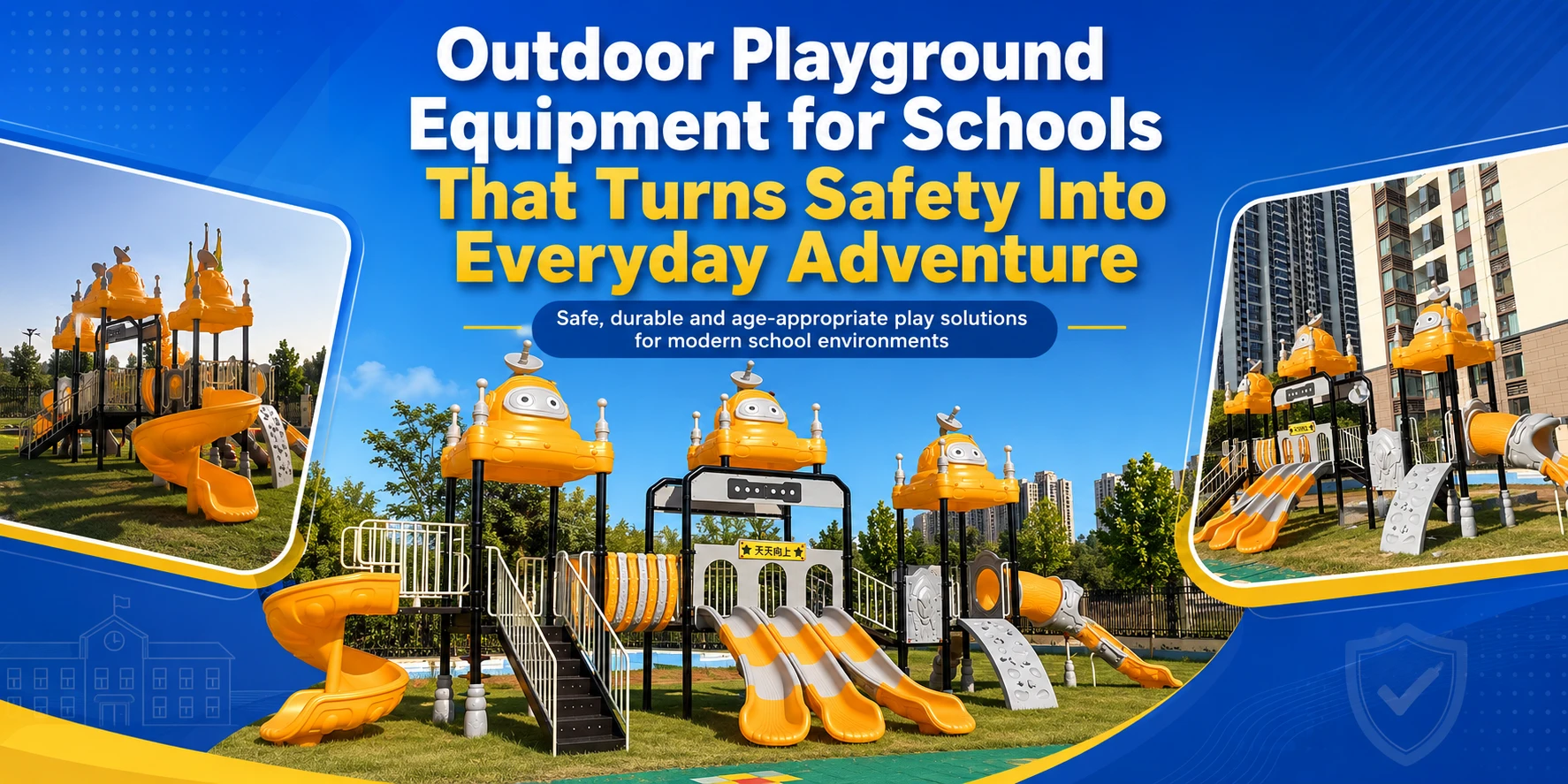
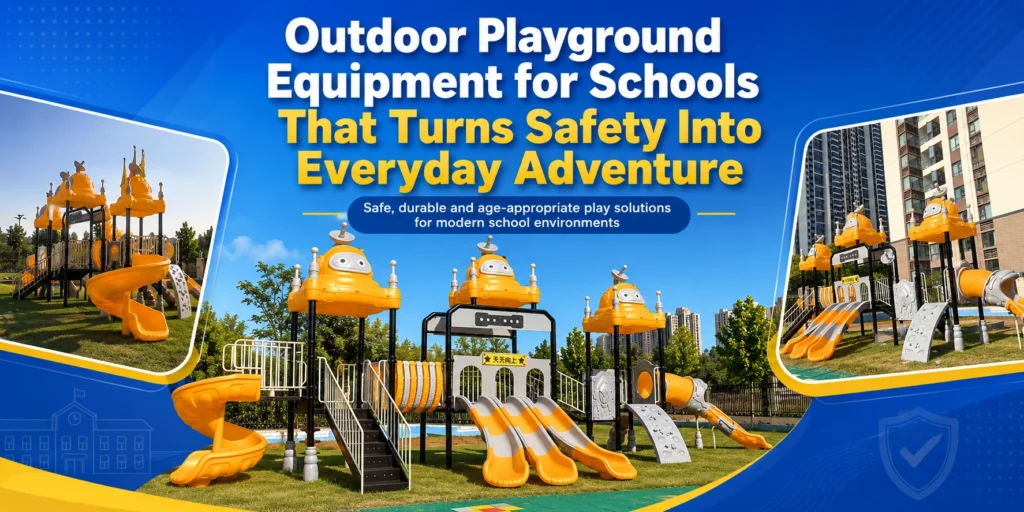
Selecting play structures for a school environment goes beyond picking colourful slides and swings. You must balance safety compliance, long‑term durability, and age suitability across early years, primary, and secondary pupils. One wrong specification can lead to costly replacements or injury risks.
Outdoor playground equipment for schools refers to dedicated play structures—climbing frames, modular play systems, swings, and balance apparatus—designed to withstand heavy daily use in educational settings. These products must meet recognised safety standards such as EN 1176 (Europe) or ASTM F1487 (US) and span the developmental needs of children aged 3 to 11.
The following sections cover the main equipment types, mandatory safety certifications, how to evaluate a reliable children playground supplier, and a step‑by‑step approach to comparing quotes.
Key Types of Outdoor Playground Equipment for K-12 Schools
School playgrounds typically combine six core equipment categories. Each serves a different developmental need and suits a specific age range. When sourcing from a kids playground equipment supplier, you must match the equipment type to the students’ age group and verify structural specifications.
- Swings – Made from metal frames with rubber, plastic, or timber seats. For preschool (2–5 years), use full-bucket seats that provide back support. For elementary (5–12), belt seats are common. Standard swing height is 2.4 m above ground; ensure an impact zone of at least twice the suspension length. Avoid chain gaps that could trap fingers.
- Slides – Plastic slide beds on metal or wood supports. Preschool slides: max height 1 m. Elementary slides: up to 2.5 m. Tube slides require double the fall zone of straight slides. Check that the bed curve has a transition angle ≤30° to prevent flat landings.
- Climbing structures – Nets, arches, or rock-wall panels in galvanised steel with HDPE (high-density polyethylene) or ropelon components. Suitable for ages 5–14. Critical spacing: no gaps between 89 mm and 229 mm to avoid head entrapment. Fall height typically 1.5–2.5 m.
- Play panels – Interactive boards (talking tubes, steering wheels, tic‑tac‑toe) mounted on metal or plastic posts. Best for preschool and lower elementary (2–7 years). Panels should have rounded edges and be at least 600 mm from the ground to prevent toe traps.
- Merry‑go‑rounds – Steel frames with rubber or Polyethylene platforms. For ages 5–12. Speed limiters are mandatory on school models; maximum rotation speed should not exceed 6 km/h. Ground-level access reduces fall risk.
- Outdoor fitness stations – Pull‑up bars, balance beams, and step platforms in powder‑coated steel. Suitable for middle school (11–14). Weight capacities must be labelled; typical max load is 150 kg per station.
A reliable school playground supplier will provide model‑specific data for each category — ask for the exact fall height, age grade, and material test reports. Match the mix to your student age groups before requesting quotes.
Safety Standards and Certifications School Buyers Must Verify
School playground equipment must meet mandatory safety standards that vary by region. The three primary frameworks are ASTM F1487 (United States), EN 1176 (Europe), and CSA Z614 (Canada). Each covers critical design parameters: maximum fall height, impact zone dimensions, hardware protrusion limits, and entrapment gap size ranges (typically between 89 mm and 230 mm). For example, EN 1176 requires a minimum 30 cm depth of loose-fill surfacing under swings with a fall height above 1.5 m.
When evaluating suppliers, always request independent test reports from an accredited laboratory — not just a letter of compliance. A complete certification package should include the product’s test certificate, the surfacing specification sheet, and the installation manual showing how you meet impact-attenuation requirements on site.
- Test report from an ISO 17025‑accredited lab confirming the model passes the relevant standard
- Compliance certificate (e.g., CE mark for EN 1176)
- Fall height rating and recommended surfacing depth for each play component
- Hardware anti‑pinch and protrusion test results
A kindergarten playground supplier that offers these documents upfront reduces your inspection burden and speeds up approval from local safety authorities.
How to Evaluate and Select Reliable Playground Equipment Suppliers
Choosing the wrong supplier for your school’s outdoor playground equipment can lead to safety failures, delayed openings, and unexpected costs. A methodical evaluation process reduces these B2B sourcing risks. Focus on four practical criteria: product quality, design variety, proven references, and after-sales support.
Product quality comes down to materials and warranty. Look for suppliers that specify steel wall thickness (e.g., 2.0 mm minimum for main posts) and UV-stabilised polyethylene for panels. A warranty covering structural components for 10–15 years signals confidence. Check that fasteners are tamper-proof and stainless steel, not zinc-plated.
Design variety matters for age-appropriate and inclusive play. Does the catalogue offer options for toddlers aged 2–5 and older children up to 12? Can you choose colours or add sensory panels for children with disabilities? A mall kids playground supplier with a wide modular range often has the flexibility to adapt for school settings.
References from schools are your strongest evidence. Ask for contact details of at least three educational clients who ordered a comparable installation. Verify the project timeline met the school calendar; a supplier that delivered a full kindergarten play area in 6 weeks during a summer break is more reliable than one that missed deadlines.
Delivery time and after-sales support are often overlooked. Request lead times for your specific equipment list, not generic estimates. Check whether the warranty covers labour for repairs and how quickly a technician can visit your site. Trade-offs between budget and durability are common: a cheaper unit may use thinner steel or a 5-year warranty instead of 15, so calculate total cost of ownership over your school’s expected 10-year usage. A kids indoor playground supplier’s track record with local schools can also indicate whether they understand regional safety audits and installation requirements.
Always verify a supplier’s track record through case studies or client testimonials before committing. This step alone can prevent months of project delays.
Step-by-Step Guide to Requesting Quotes and Comparing Proposals
Once you’ve shortlisted suppliers, the next phase is gathering comparable quotes. Follow these steps to avoid hidden costs and compliance gaps.
-
Define your project scope in writing. List the exact equipment types (slides, climbing frames, swings), site dimensions, fall-zone surfacing area, and a realistic budget range. Include any customisation needs like school colours or inclusive-access features. Without this, quotes become unverifiable estimates.
-
Send a request for quotation (RFQ) to three to five suppliers. Include your scope document and ask for: itemised pricing, delivery lead time, warranty period, installation cost, and certification copies. Ensure each RFQ asks the same questions so you can compare like-for-like.
-
Compare proposals across five key criteria. Use this checklist to score each quote:
- Price – total cost including delivery and installation
- Certifications – verifiable compliance with ASTM F1487 or EN 1176
- Lead time – from order to site delivery (typical: 6–12 weeks)
- Warranty – years covered for structure, moving parts, and UV degradation
-
Installation services – whether ground prep and assembly are included
-
Request references and arrange site visits. Ask for two or three recent school projects of similar scale. Visit an installed site to inspect weld quality, bolt finishes, and wear after one season of use.
Red flags to watch for: refusal to share certification documents, vague warranty wording (‘limited coverage’ without specifics), lead times quoted as ‘to be confirmed’, or missing line items for freight and groundwork. A reputable kids outdoor playground supplier will provide clear, itemised proposals for safe kids playground equipment without prompting.
About JQ Playground – kidsplaygroundsupplier.com
JQ Playground (Wenzhou Jiqi Amusement Equipment Co., Ltd.) is a children’s playground equipment manufacturer founded in 1993. The company provides design, customization, large-scale manufacturing, sales, installation guidance, and after-sales support for outdoor playgrounds, indoor playgrounds, soft play, water playgrounds, PE board playgrounds, kindergarten furniture, outdoor fitness equipment, pet playgrounds, and playground facilities. Approved company facts include 180+ employees, a large Wenzhou production base, 20+ production lines, 55 production machines, ISO/BSCI/EN1176/EN71/ASTM/CPC/CPSIC certification references, 100+ patents, free design support, OEM/ODM capability, trial installation before shipping, export experience, and one-year quality warranty.