
Families with children under four are the hardest audience to retain, yet most play centres lose them. Standard play frames intimidate toddlers or cause injury risks, so parents leave early and sessions end. For buyers and planners, the challenge is sourcing equipment that satisfies safety-conscious adults and restless 1–3-year-olds without sacrificing margins.
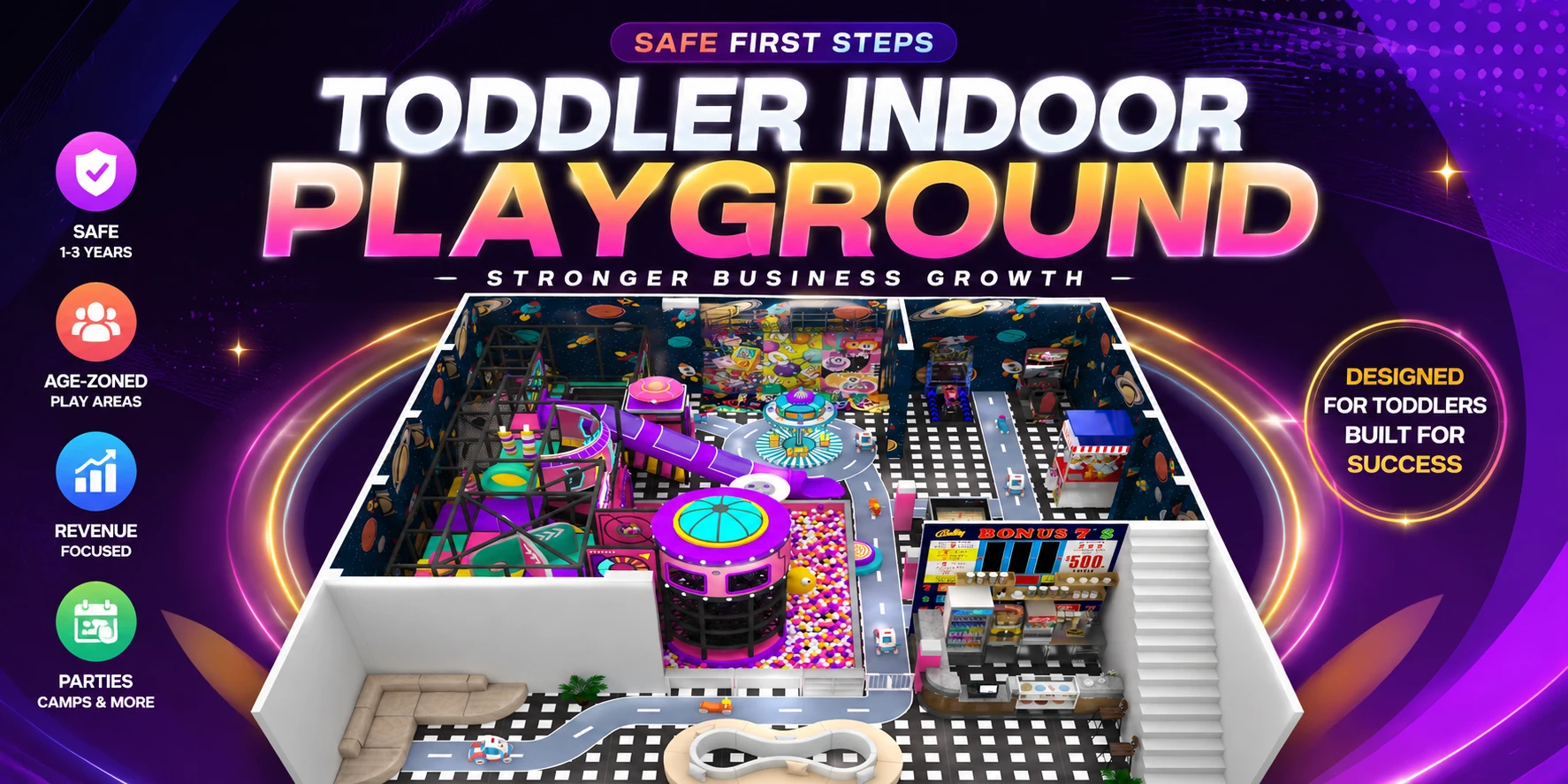
A toddler indoor playground is an indoor play environment intentionally designed for children ages 1–3, with soft play structures, ride-ons, tactile features, and safe surfacing.
Getting this right means balancing child safety, family appeal, and revenue from day one. That balance affects every decision ahead of you: how you divide floor space into age-segmented zones, which certified equipment and flooring you specify, how you price admissions against local competition, and which party or camp programmes turn underused hours into profit. Each choice compounds, so working through zone planning, equipment specs, pricing models, and programming in order protects both your youngest visitors and your business plan.
Design Age-Segmented Zones for Toddler Indoor Playgrounds
Separate the calm 12–24 month crawler zone from the active 2–3 year space with low, see-through barriers. The goal is one supervising sightline: a parent can watch a tentative first walker while a confident three-year-old rides or climbs nearby without collision risk.
Successful layouts allocate roughly 60–70% of the toddler floor to active play and the rest to quiet corners. Keep each zone compact so adults can intervene within a few steps.
Zone components that work in local centres:
- Low foam climbers and soft steps for early walkers
- Shallow ball pools for safe tumbling and sensory play
- Ride-on tracks with padded edges for pedal cars and push-alongs
- Sensory panels with gears, mirrors and varied textures at seated height
- Role-play corners with mini kitchens or shop counters for parallel play
Position adult seating along every zone perimeter, roughly one seat per 8–10 m², so children remain in clear line of sight at all times.
Select Certified Equipment and Flooring for 1–3 Year-Old Play Spaces
Sourcing a toddler indoor playground starts with equipment certified to commercial standards and designed specifically for ages 1–3. Toddler units need shorter climbs, wider bases and lower fall heights; scaled-down school-age kit often fails on entry height, gap spacing and impact zones. Specify non-toxic, lead-free finishes, rounded edges and closed-cell foam that resists moisture. Pair every unit with impact-absorbing flooring rated for its actual fall height, then contain the space with low visual barriers and self-closing gates.
Component specification examples:
- wipe-clean antimicrobial foam covers with no exposed zips or seams
- low platforms with guardrails at toddler chest height
- ride-ons with fixed bases and no pinch points
- interlocking rubber or foam flooring with sealed edges
- barriers around exits, stairs and ball-pool openings
Ask suppliers for material and finish test certificates before ordering, and confirm every component carries a toddler-specific age rating.
Benchmark Toddler Play Venue Admission and Membership Pricing
Typical opening rates at urban toddler indoor playgrounds sit between £7 and £12 for one child, with discounts for siblings. Realistic benchmarks to model:
- Single-visit admission for one child: £8–£11
- Five-visit multi-session pass: £35–£45
- One-month unlimited play, one child: £40–£60
- Sibling admission: 10–20% discount
- Birthday party package with play time: £180–£350
Compare these against rent, staffing, and equipment depreciation. If monthly rent and wages come to £8,000, a £10 average ticket demands 800 single visits just to break even. Unlimited passes sell slower but renew monthly, which stabilises cash flow and fills weekday mornings. Keep equipment quotes separate as a capital cost line, then test different pass mixes against your projected footfall before ordering.
Add Party, Camp, and Open-Play Programs to Maximize Revenue
Leading venues treat open play as the anchor, not the full menu. The Play Pad’s published offer splits into ‘Play Time,’ ‘Birthday Parties’ and ‘Camps & Events’ — clear proof that a toddler indoor playground earns across several booking streams, not just at the door. Plan the floor space to support that structure from day one:
- Party rooms for 8-12 children, with wipe-clean tables for food, cake and crafts.
- A flexible hall that converts between camp sessions, holiday clubs and drop-off care.
- A separate check-in point so booked groups never clash with pay-at-door families.
Weekday mornings suit camps and toddler group sessions, when single-visit footfall is thin. Weekends fill with parties from 10am onwards. Each bookable area then generates two revenue lines: play admission and room hire.
About JQ Playground – kidsplaygroundsupplier.com
JQ Playground (Wenzhou Jiqi Amusement Equipment Co., Ltd.) is a children’s playground equipment manufacturer founded in 1993. The company provides design, customization, large-scale manufacturing, sales, installation guidance, and after-sales support for outdoor playgrounds, indoor playgrounds, soft play, water playgrounds, PE board playgrounds, kindergarten furniture, outdoor fitness equipment, pet playgrounds, and playground facilities. Approved company facts include 180+ employees, a large Wenzhou production base, 20+ production lines, 55 production machines, ISO/BSCI/EN1176/EN71/ASTM/CPC/CPSIC certification references, 100+ patents, free design support, OEM/ODM capability, trial installation before shipping, export experience, and one-year quality warranty.