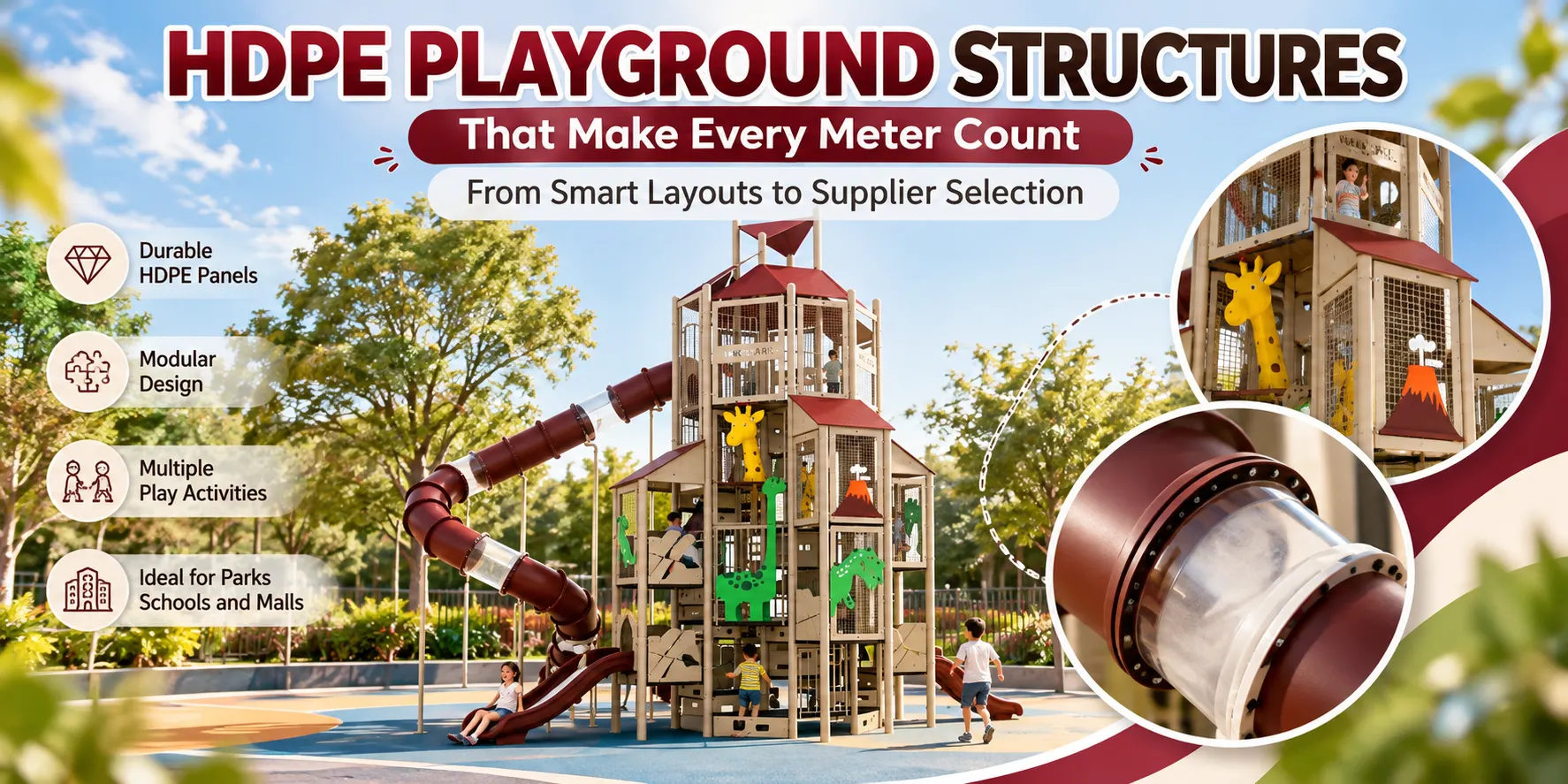
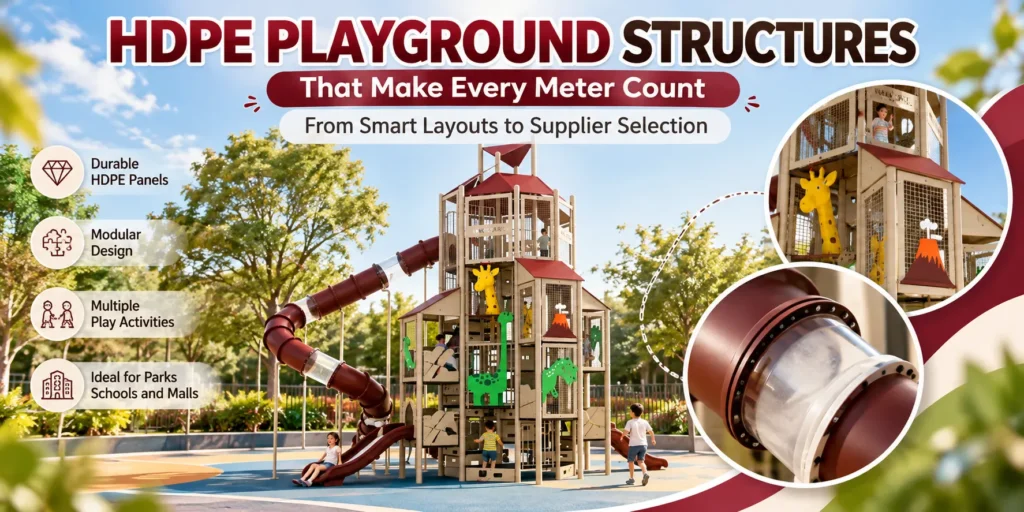
Planning play equipment for a school yard, kindergarten or park often stalls on layout fit, not colour: a 2–5 age zone needs different deck heights, slide lengths and clearances from a 5–12 zone. HDPE playground structures are modular play systems made from moulded high-density polyethylene parts—towers, climbing panels, slides and activity units—assembled into fixed or customised layouts for children’s play areas. The next step is comparing model formats, listed dimensions and price signals before you shortlist a kids playground supplier.
HDPE Playground Structures: Model Formats, Dimensions, and Listed Price Signals
Supplier pages commonly present HDPE/DHPE playground structures as model-coded packages, play towers, slide sets, climbing panels or multi-activity units. A tower count, slide quantity and panel count define the package, while configuration notes flag left- or right-hand slides and add-on activity panels. Listed dimensions should follow length × width × height in cm or ft, backed by a component list; if either is missing, compare another page. Price signals vary: some listings publish an FOB range, others use “request a quote” or “price on application”. A 3-tower package with 2 slides and 4 panels is a usable like-for-like baseline; a page quoting only total weight is not. Material choice then becomes the next filter.
Material Performance and Category Fit: HDPE vs Recycled Plastic vs Modular Structures
The split is practical, not cosmetic. HDPE playground structures shrug off rain and rot, feel smooth rather than splintered, and can be swapped panel-by-panel; UV exposure fades colour, dark grades heat up, and temperature swings cause expansion, so leave fixing gaps on sunny sites. Recycled plastic is denser and often heavier, with performance tied to mix quality; ask for colour-fastness and screw-fixing details. Modular systems combine galvanised steel frames with HDPE or recycled panels — metal risks rust at cut edges, wood risks rot and splinters, yet modular repair is usually faster because posts and panels separate.
Match category to venue: a kindergarten playground supplier often needs compact, low-maintenance HDPE units; a community playground supplier may prefer modular packages for phased repair. Parks suit modular layouts; mall family zones favour compact HDPE; constrained sites need L-shaped modules. Fix material first, then age band and footprint determine capacity.
Age Bands, Capacity, and Footprint Planning for HDPE Play Structures
Category pages split HDPE playground structures into 2–5 and 5–12 bands. Plan in this order:
- Age band: 2–5 units list 0.6–1.2 m decks and 1.5–2.5 m slides; 5–12 packages move to 1.2–2.0 m decks and 2.5–4.0 m slides.
- User count: 20 kindergarten children need 8–10 play events; a 60-user park package lists 15–20.
- Footprint: compact layouts start at 6 m × 8 m; park packages reach 12 m × 15 m.
- Modules: use L-shaped towers below 8 m depth; add bridges and a third slide on larger sites.
- Clearances: allow 1.5–2 m at slide exits, 1.2 m between modules, and a 0.45–0.5 m transfer platform for accessible entry.
A mall kids playground supplier can fit a 4 m × 6 m L-shaped unit with shade over the slide run. Confirm these figures against a layout drawing and component list before sourcing.
Sourcing HDPE Playground Structures: Custom Layouts, Quotes, and Supplier Evidence
Your RFQ should make every custom HDPE package directly comparable. Ask each kids outdoor playground supplier for:
- A scaled site plan or layout drawing, including access routes and clearances.
- The full component list: decks, slides, climbing panels, posts, fixings and counts.
- Dimensions in cm and ft for each module, plus the assembled footprint.
- Installation scope: setting-out, anchors, and the surfacing interface.
- Packaging and export marks if shipping, with lead-time assumptions from deposit to dispatch.
- Model pages and project photos that match the quoted configuration.
Read that evidence against your site. A 350 cm × 450 cm footprint can leave 60 cm beside a boundary wall, not the 1.5 m shown. Check model codes and option lists; when figures conflict, request a dimensioned drawing. Keep safe kids playground equipment checks tied to visible components.
About JQ Playground – kidsplaygroundsupplier.com
JQ Playground (Wenzhou Jiqi Amusement Equipment Co., Ltd.) is a children’s playground equipment manufacturer founded in 1993. The company provides design, customization, large-scale manufacturing, sales, installation guidance, and after-sales support for outdoor playgrounds, indoor playgrounds, soft play, water playgrounds, PE board playgrounds, kindergarten furniture, outdoor fitness equipment, pet playgrounds, and playground facilities. Approved company facts include 180+ employees, a large Wenzhou production base, 20+ production lines, 55 production machines, ISO/BSCI/EN1176/EN71/ASTM/CPC/CPSIC certification references, 100+ patents, free design support, OEM/ODM capability, trial installation before shipping, export experience, and one-year quality warranty.