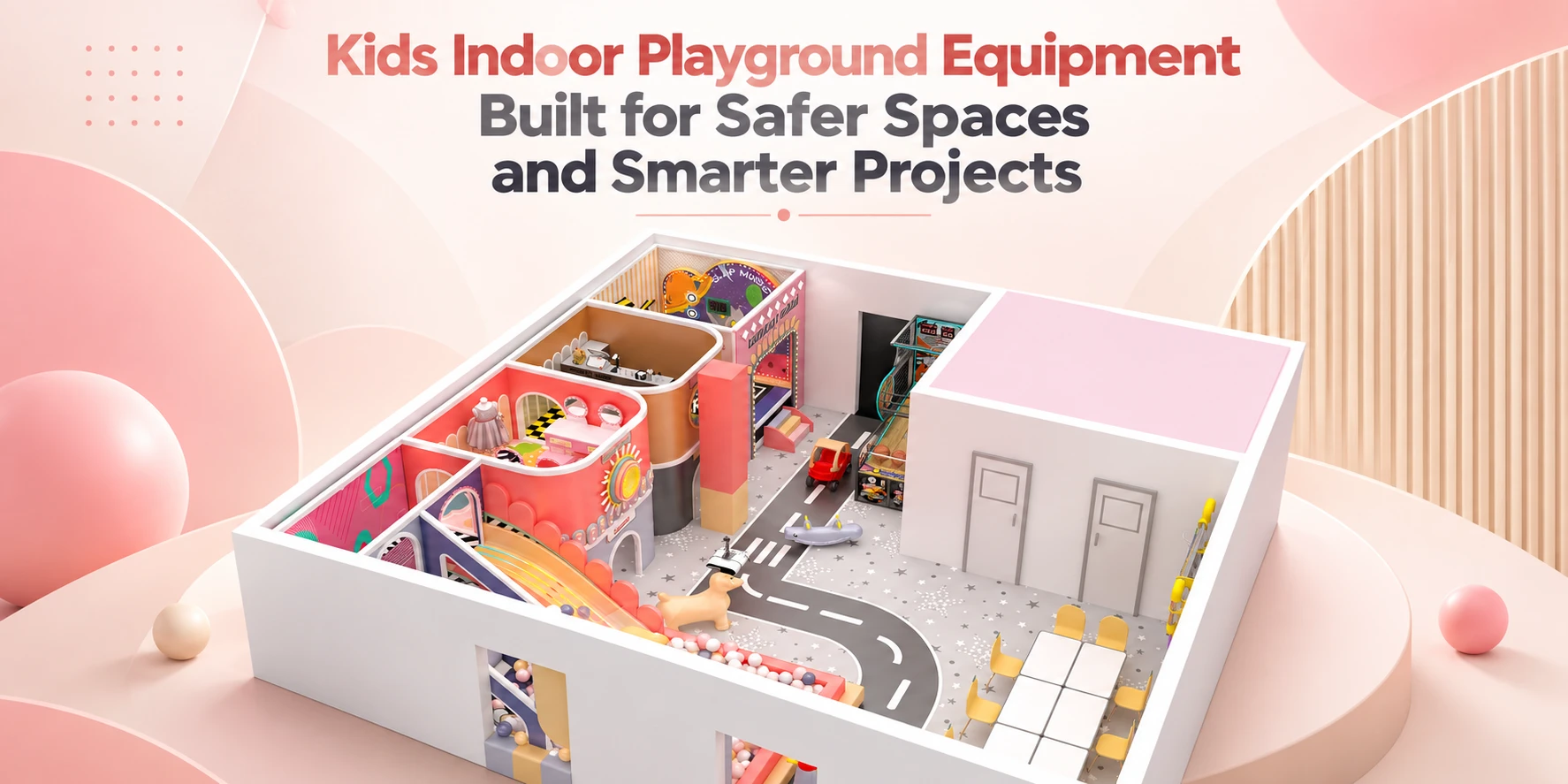
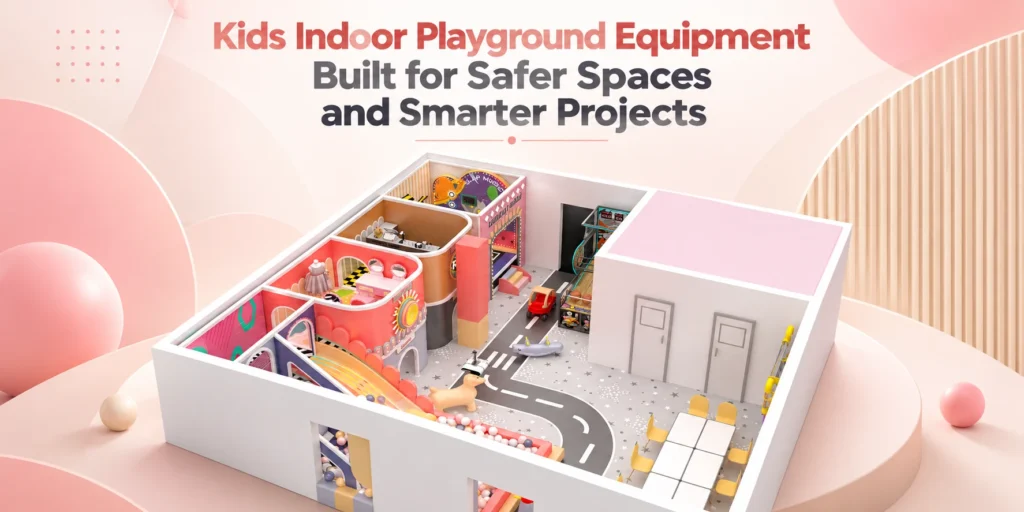
Sourcing kids indoor playground equipment for a school hall, nursery, or mall family zone carries hidden risk. Safety compliance gaps, incorrect age grading, and floor-space miscalculations surface only after installation. One slide that fails inspection, or a unit blocking a fire exit, can delay your opening for weeks and inflate project costs. The solution is to compare structure, safety, and application fit before you commit — and to work with a responsive kids playground supplier who verifies every detail.
Kids indoor playground equipment is a category of safety-tested play structures built for enclosed, climate-controlled spaces such as nurseries, school halls, community centres, and mall family zones. The range covers climbing frames, slides, ball pits, soft play blocks, trampolines, and themed activity panels. Unlike outdoor sets, indoor units must fit fixed ceiling heights, satisfy stricter fire-retardant and hygiene standards, and match specific age bands — usually toddlers to under-12s. Buying decisions therefore hinge on modular design, floor-plan fit, safety certification, ease of cleaning, and supplier lead times.
First, understand how safe, durable indoor play systems are engineered and what to inspect when sourcing.
How Kids Indoor Playground Equipment Works
An indoor play system pairs a load-bearing frame with graduated activity zones and impact-absorbing surfacing. The operating sequence is straightforward:
- The frame transfers static and moving loads to the floor through bolted anchors.
- Platforms, slides, nets and tunnels form a circuit matched to the children’s age range.
- Fall zones under every exit absorb impacts from that platform’s maximum height.
- Guardrails, gap limits and capped fasteners remove entrapment and pinch hazards.
- Routine joint and surfacing checks confirm the safety state repeats daily.
What each component contributes
The frame carries load; connectors link sections without sharp edges; decks set the fall height; foam absorbs low-energy impact; and netting contains movement without blocking sightlines. This same layout logic should appear in a supplier’s drawing so you can compare fall zones and anchor methods against your hall measurements before purchase.
Kids Indoor Playground Equipment Components and Product Types
Most purchases come down to five product families, and each changes how much floor space, fall protection and installation work you need to quote.
| Product type | Example configuration | Priority buyer check |
|---|---|---|
| Soft play modules | Slides, ball pits, climb-and-crawl blocks | Foam density and wipe-clean vinyl grade |
| Frame-based climbing units | Climbers, bridges, tube slides | Fall height against matting depth |
| Trampolines and bouncers | Recessed or freestanding | Enclosure mesh and anchor specification |
| Obstacle and ninja courses | Platforms, cargo nets, balance beams | Load rating at every anchor point |
| Sensory and electric play | Light panels, bubble tubes | Electrical safety and IP rating |
When comparing quotes, request the same specification set from a kindergarten or community playground supplier:
- Age range and maximum user height the design allows
- Core material grade: HDPE, coated steel or plywood
- Maximum user weight per component
- Impact-area and pinch-point tests against your target standard
Ask for these details on the drawing itself. Consistent documentation makes your site inspection and sign-off far simpler.
Typical Applications for Kids Indoor Playground Equipment
Schools and nurseries usually prefer low-level soft play sets with cushioned flooring, because daily rotation across age groups demands easy reconfiguration and wipe-clean surfaces. If you equip several classrooms or branch sites, ask for batch pricing early.
Mall family zones and entertainment centres need taller multi-level structures fixed to both floor and wall. Confirm connector spacing, safety netting, and sightlines against your floor plate before ordering.
Community halls and park owners mix standalone slides, swings, and sensory panels, so verify that every piece uses compatible fixing hardware and the same safety surfacing.
Distributors sourcing for multiple clients should request installation drawings, spare-part lists, and third-party safety test reports per unit.
Once the build type fits the venue, you can compare standard catalogue options against a custom layout tailored to your space.
Custom Kids Indoor Playground Equipment Manufacturing and OEM Cooperation
Custom manufacture begins where catalogue options end. To get an accurate price for kids indoor playground equipment, send dimensioned drawings, reference photos, or a physical sample so the factory can assess platform sizes, slide radii, and safety clearances before quoting.
| Stage | Buyer input | Manufacturer output |
|---|---|---|
| Design and quote | Drawings, photos, or sample; target quantity; delivery deadline | Feasibility check, material list, itemised quote |
| Sample confirmation | Approval or revision notes on the pre-production sample | Corrected sample plus colour and logo proofs |
| Packaging | Carton, flat-pack, or pallet preference | Packing list and loading diagram |
| Batch inspection | Your inspector’s checklist or third-party booking | Inspection report and remedy plan |
| Shipment | Destination port and incoterms | Shipping documents and tracking updates |
Batch Inspection Detail
Most OEM buyers book a mid-production check and a pre-shipment inspection. Agree a defect threshold for welded joints, foam density, and guardrail spacing before containers are sealed.
Once you know each stage, the next step is choosing a factory that can execute it dependably.
Top 10 Kids Indoor Playground Equipment Manufacturers and Supplier Fit
No universal top ten exists; the best kids indoor playground equipment factory depends on your buying route. A firm that executes OEM stages well still has to match your project scale and maintenance appetite.
| Supplier type | Pros | Cons | Best fit |
|---|---|---|---|
| Full-line manufacturer | One contract: design, testing, install | High minimum spend | Malls, big community centres |
| Modular soft-play maker | Fast lead times, compact freight | Limited custom structures | Schools, toddler zones |
| Custom OEM workshop | Themed, sample-first builds | Needs measured drawings | Park-specific concepts |
| Local distributor | On-site service, spare parts | Weak factory pricing | High-maintenance sites |
Score candidates on:
- Certified EN 1176 or ASTM F1487 per batch
- Fire-retardant materials declared in writing
- Load-test reports for anchors and frames
- Age appropriate playground equipment zones on approved 3D renders
- Named children play area supplier contact for spares
Source the factory you can inspect, not the one that answers fastest.
About JQ Playground – kidsplaygroundsupplier.com
JQ Playground (Wenzhou Jiqi Amusement Equipment Co., Ltd.) is a children’s playground equipment manufacturer founded in 1993. The company provides design, customization, large-scale manufacturing, sales, installation guidance, and after-sales support for outdoor playgrounds, indoor playgrounds, soft play, water playgrounds, PE board playgrounds, kindergarten furniture, outdoor fitness equipment, pet playgrounds, and playground facilities. Approved company facts include 180+ employees, a large Wenzhou production base, 20+ production lines, 55 production machines, ISO/BSCI/EN1176/EN71/ASTM/CPC/CPSIC certification references, 100+ patents, free design support, OEM/ODM capability, trial installation before shipping, export experience, and one-year quality warranty.