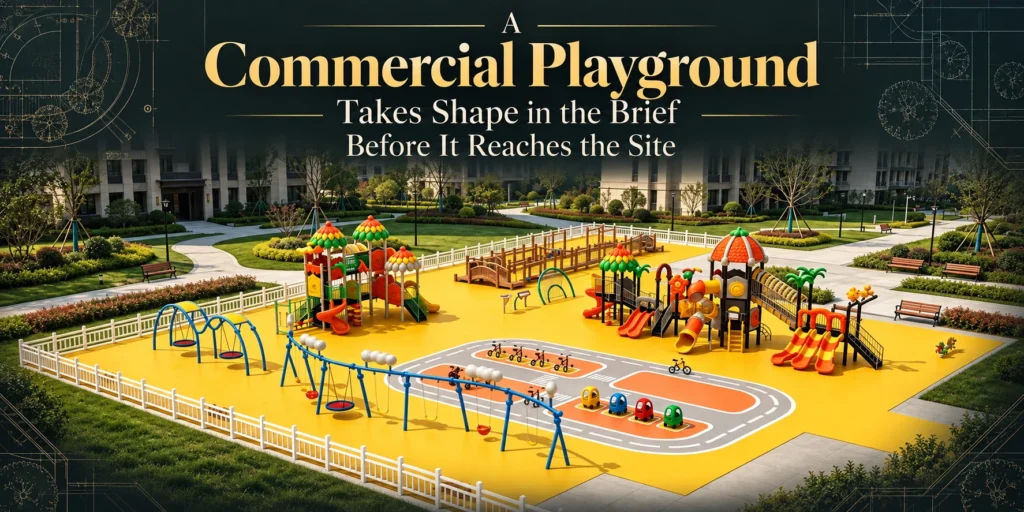
A vague commercial playground brief costs time and money. One wrong deck height, a missing age split, or an unverified fall height can stall approval and push installation back weeks — and every supplier quote you collect afterwards describes a different product. Fix the specification first: age band, capacity, use frequency, site dimensions, and surfacing depth.
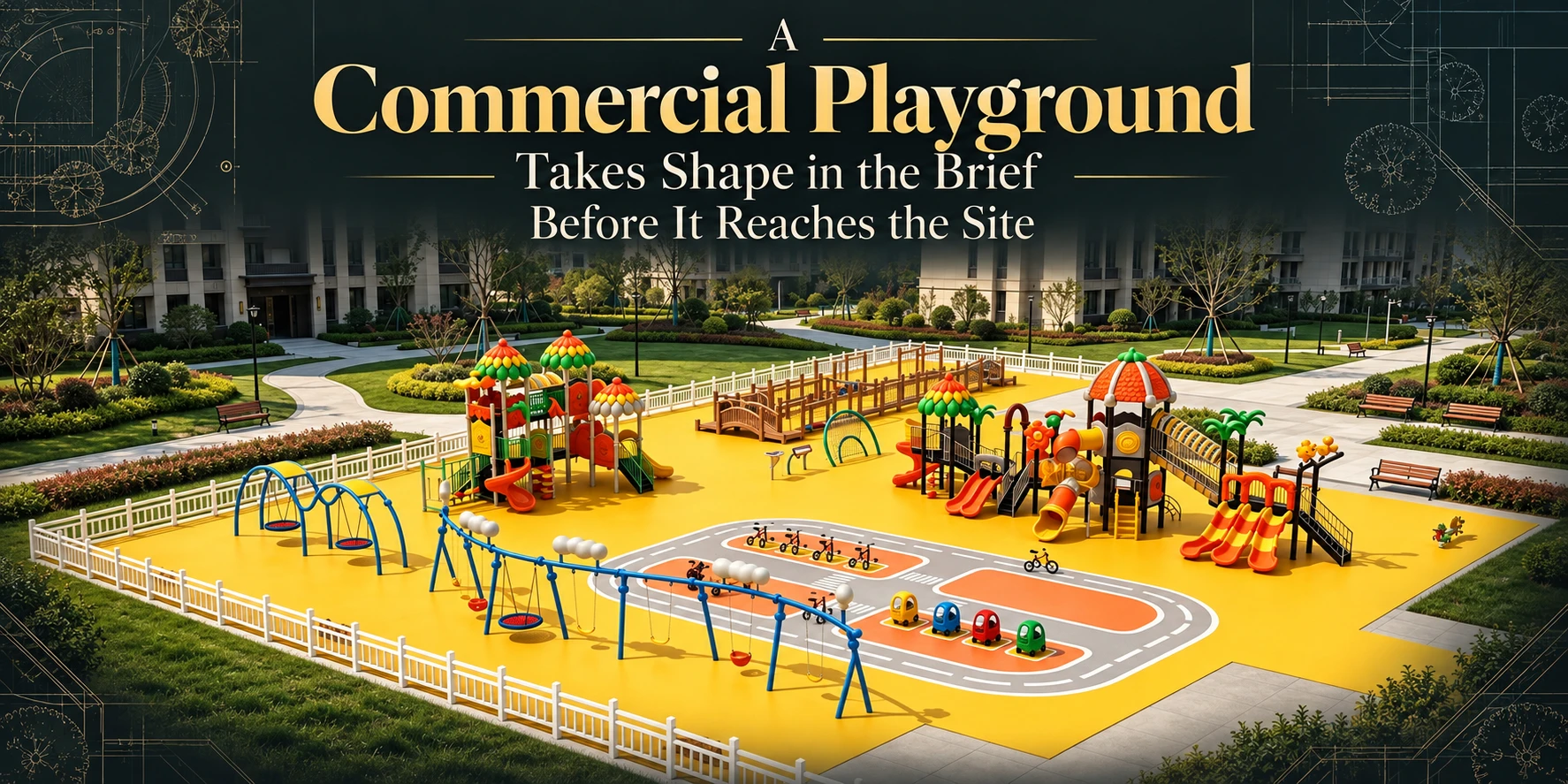
A commercial playground is a permanently installed play structure designed for public, institutional, or commercial sites — schools, kindergartens, parks, housing estates, and shopping centres — not domestic gardens. It is specified by age band (usually 2–5 or 5–12 years), user capacity, fall height, and safety surfacing depth, and built to standards such as EN 1176 or ASTM F1487. Typical components include decks, slides, climbing frames, swings, and guardrails in steel, aluminium, or HDPE.
Choosing a children playground supplier starts with the same question: what must the structure do, and for whom?
How Commercial Playground Works
A commercial playground runs as a fixed loop: children enter, move through, then exit at set points. Each stage maps to a buyer check you can make before ordering.
- Entry and access — age-banded routes set deck heights and step risers, so confirm the age group first.
- Climb and crawl — ladders, ramps and nets turn effort into height; check fall height against your local safety standard.
- Slide, swing and balance — moving parts take the load; ask which components are replaceable, since repeatability depends on spare parts.
- Impact zone — surfacing depth follows fall height, so match it to your surface type before approving drawings.
What each component does
Posts and decks carry load. Clamps and fastenings hold alignment. Slides, swings and play panels deliver the play value. Ask a school playground supplier which parts wear fastest.
If fall height and surfacing depth are not signed off together, installation stalls on site.
Commercial Playground Components and Product Types
With the install sequence agreed, the next buying decision is product family. Most commercial playground packages mix four or five of the following:
| Product family | Typical age band | Main buyer check |
|---|---|---|
| Multi-play towers | 3–12 | Deck height, post diameter, slide count |
| Swing frames | 2–12 | Bay width, seat type, frame steel gauge |
| Spring rockers | 2–5 | Spring rating, handle grip, base plate |
| Sensory and panel play | 2–8 | Panel material, fixing points, spare parts |
| Climbing nets and walls | 5–12 | Rope diameter, mesh size, anchor plates |
Specification details to confirm before an RFQ:
- Post material and wall thickness, plus coating type
- Plastic thickness for slides, roofs and panels
- Fastener grade and anti-tamper fixings
- Spare part availability for high-wear items
A community playground supplier usually quotes families separately, so group your line items by site type before shortlisting.
Typical Applications for Commercial Playground
Application fit shapes the specification far more than catalogue size does.
- Schools and kindergartens: climbing frames, slides and swing sets sized for ages 3–12; order by age band and request inspection records for each delivered unit.
- Malls and family zones: soft-play modules, ball pools and themed structures built for indoor footprints; a mall kids playground supplier should show flame-retardant fabric evidence and spare-part lists.
- Parks and community sites: steel or aluminium posts with anti-corrosion coating; confirm post diameter, connector gauges and footing plans.
| Application factor | Buyer action |
|---|---|
| Batch demand | Confirm batch sizes per product family |
| Connector fit | Match clamp size to post diameter |
| Quality evidence | Ask for per-batch inspection records |
Those patterns carry straight into custom builds, where drawings and samples set the final specification.
Custom Commercial Playground Manufacturing and OEM Cooperation
Custom and OEM builds follow one confirmation path: drawings, CAD files, or a sample unit define layout, post spacing, and play events. The table maps buyer input to manufacturer output at each stage.
| Stage | Buyer input | Manufacturer output |
|---|---|---|
| Drawing or sample | Dimensioned drawing, sample unit, colour reference | Feasibility note, material list, quotation |
| Sample confirmation | Signed sample or golden sample approval | Pre-production sample, specification lock |
| Packaging | Carton marking, pallet plan, logo artwork | Packing drawing, label proof |
| Batch inspection | AQL level, checkpoints, photo request | Inspection report, photos, test data |
| Shipment | Delivery window, port, document list | Loading plan, container photos, shipping docs |
Before dispatch, confirm weld quality, bolt torque, coating thickness, and hardware count against the approved sample. For safe kids playground equipment, request impact-test records for the surfacing zone and load ratings for each deck. Then compare suppliers on sample speed, inspection depth, and lead-time reliability.
Top 10 Commercial Playground Manufacturers and Supplier Fit
Shortlist by capability, not catalogue size. Five supplier types cover most commercial playground tenders: global premium play brands, regional steel fabricators, OEM/ODM export factories, modular component suppliers, and turnkey installers. Check age range coverage (2–5 and 5–12), post diameter, deck height limits, and spare-part supply after handover.
| Supplier type | Pros | Cons | Best fit |
|---|---|---|---|
| Global premium brands | Full test files, wide age appropriate playground equipment range | Highest unit cost, 12–20 week waits | Schools, public parks, audit-heavy bids |
| Regional fabricators | Fast local delivery, small batches | Narrow design library, variable coating | Contractors fitting 1–3 sites |
| OEM/ODM export factories | Low unit cost at 100+ sets, custom colours and logos | Long shipping, buyer-funded QC | Distributors and children play area supplier stockists |
| Modular component suppliers | Buy decks, slides and climbers separately | You coordinate assembly and surfacing | Community groups upgrading one zone |
| Turnkey installers | One contract for supply, install, surfacing | Least transparent on component origin | Mall family zones with fixed opening dates |
Score every supplier on the same three documents — impact test report, coating thickness reading, and fastener schedule — so price comparison stays fair.
- Weight safety evidence at 40%, lead-time reliability at 20%, price at 20%, sample speed at 20%.
- Reject any quote missing deck load ratings or surfacing depth figures.
- Confirm colour and logo approval before powder-coat runs.
The closing section shows how to turn these scores into an award decision.
About JQ Playground – kidsplaygroundsupplier.com
JQ Playground (Wenzhou Jiqi Amusement Equipment Co., Ltd.) is a children’s playground equipment manufacturer founded in 1993. The company provides design, customization, large-scale manufacturing, sales, installation guidance, and after-sales support for outdoor playgrounds, indoor playgrounds, soft play, water playgrounds, PE board playgrounds, kindergarten furniture, outdoor fitness equipment, pet playgrounds, and playground facilities. Approved company facts include 180+ employees, a large Wenzhou production base, 20+ production lines, 55 production machines, ISO/BSCI/EN1176/EN71/ASTM/CPC/CPSIC certification references, 100+ patents, free design support, OEM/ODM capability, trial installation before shipping, export experience, and one-year quality warranty.