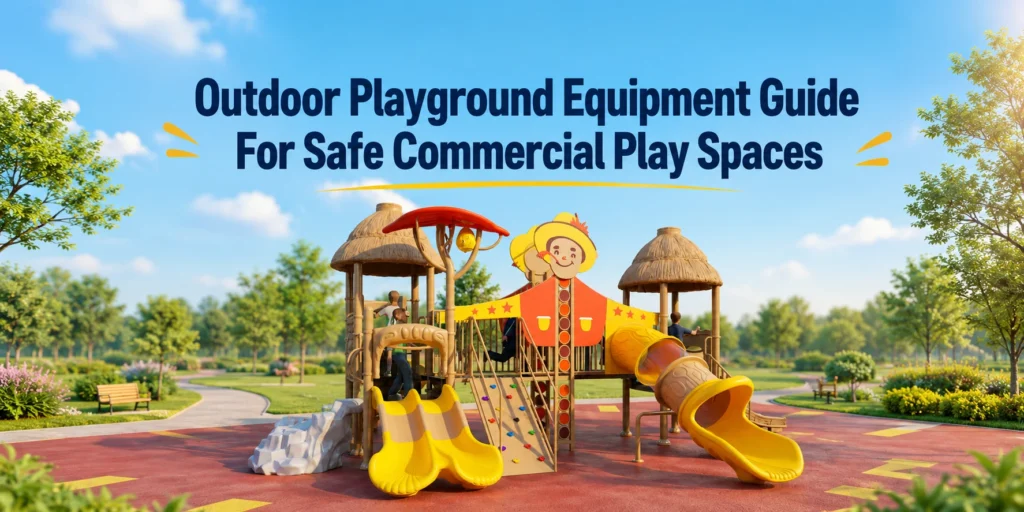
Whether you’re outfitting a new school playground or replacing worn equipment in a community park, you face a common challenge: finding outdoor playground equipment that is durable, safe, and within budget. School buyers, park planners, and community operators all need structures that comply with regulations while standing up to heavy daily use.
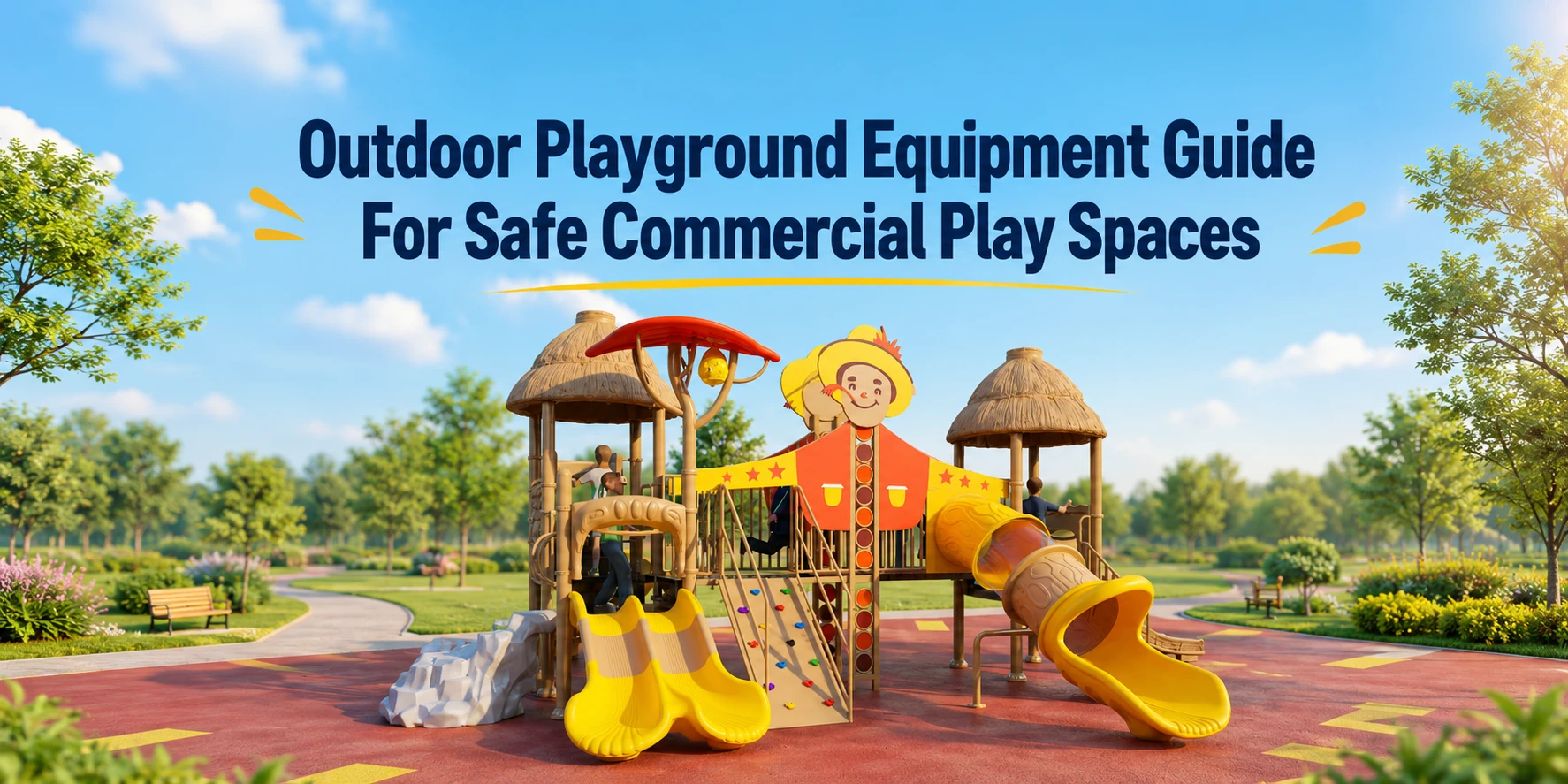
Outdoor playground equipment refers to commercial-grade play structures, swings, slides, climbers, and inclusive units designed for public use in schools, parks, malls, and community spaces. This category covers everything from modular play towers to freestanding spinners and accessible sensory panels. Buyers typically start by evaluating a potential kids playground supplier’s product range, material quality, and compliance documentation.
This guide covers the essential equipment types, key safety standards (ASTM, EN1176, CSA, AS 4685), selection criteria for your venue, and practical supplier considerations.
Essential Types of Outdoor Playground Equipment for Commercial Spaces
Commercial playgrounds typically fall into four main categories: modular systems, freestanding pieces, inclusive units, and climbing structures. Each type serves different play values, age groups, and spatial constraints.
Common equipment types:
– Modular playground systems – multi-activity structures combining slides, platforms, tunnels, and overhead elements. Best for maximising play value in a compact footprint.
– Freestanding equipment – swings, slides, spinners, see-saws, and spring riders. Easy to add individually to complement a modular setup.
– Inclusive play units – designed with ramps, transfer platforms, ground-level panels, and sensory activities to meet ASTM F1487 and EN1176 accessibility requirements. A 2021 CPSC report notes that inclusive designs can reduce injury rates by enabling safer, supervised play.
– Climbing structures – rope climbers, rock walls, arches, and dome climbers. These build motor skills for children aged 5–12.
Materials comparison (durability vs. cost):
| Material | Typical Lifespan | Maintenance Needs | Relative Cost |
|---|---|---|---|
| Rotationally moulded polyethylene | 10–15 years | Wash with mild soap annually; check UV stabilisation | Moderate |
| Powder-coated steel | 15–20 years | Inspect welds and coatings every 6 months; repaint when chipped | Moderate-high |
| Pressure-treated wood | 8–12 years | Re-stain every 2 years; check for splinters and rot | Low-moderate |
Age-appropriate design is critical. For toddlers (2–5 years), platforms below 600 mm, gentle slides, and enclosed play decks are required under EN1176. School-age children (5–12) can use structures up to 3 m fall height with more challenging climbing elements. Always confirm that a kids playground equipment supplier or school playground supplier provides age-labelled layouts and compliance certificates with every quote.
Key Safety Standards and Certifications for Outdoor Playgrounds
Four standards govern commercial playground safety worldwide: ASTM F1487 (US), EN1176 (Europe), CSA Z614 (Canada), and AS 4685 (Australia). Each sets rules for fall height, impact-absorbing surfacing, equipment spacing, and entrapment prevention. The CPSC records over 200,000 playground injuries each year; falls to the surface account for the majority. Proper surfacing reduces that risk by 60%.
✅ Fall height limits dictate surface material and depth. EN1176 caps free height at 3 m for school-age equipment, requiring at least 300 mm of loose-fill or certified rubber tiles beneath.
✅ Spacing requirements prevent collisions. European standards demand a minimum 2 m between structures; ASTM F1487 specifies 6 ft clear zones around moving elements such as swings.
✅ Entrapment hazards are controlled by restricting openings between 89 mm and 230 mm — wide enough for limbs to pass but narrow enough to block head entry.
Buyers must verify supplier certifications with third-party test reports, not just a paper certificate. Every model should be tested to the relevant standard by an accredited laboratory, whether you are sourcing from a kindergarten playground supplier or a community playground supplier. Cross-check fall height against your chosen surfacing, spacing against your site plan, and entrapment tests against probe requirements. These verifications protect children and reduce your organisation’s liability.
How to Select the Right Playground Equipment for Your Venue
Once you have confirmed the safety standards your supplier must meet, the next step is to match the equipment to your site, audience, and operational budget. This five-step process will help you shortlist the right options.
- Assess available space and budget. Measure the total site area, including required fall zones (typically 1.5–2.5 m around each structure). Budget should cover not just the equipment but also surfacing (e.g., wet-pour rubber at £40–£70/m²), installation, and contingency. A typical commercial playground package runs from £15,000 to £100,000+ depending on size and complexity.
- Determine target age group and user capacity. ASTM and EN1176 standards split equipment into age groups: 2–5 years (low platforms, short slides) and 5–12 years (taller climbers, longer slides). Estimate peak users per hour — a school playground may need 50–80 children at once — and choose modular systems that scale.
- Choose between modular vs. custom designs. Modular units offer faster lead times (8–12 weeks) and fixed pricing, while custom builds allow site-specific fits (e.g., irregular shapes, existing trees). If you need a themed playground for a mall kids playground supplier, custom is common; for standard school grounds, modular often works.
- Evaluate supplier reputation and installation services. Request references, check lead time reliability, and clarify whether installation is performed by the supplier’s team or subcontracted. Shipping costs and site preparation (e.g., concrete footings, drainage) can add 15–25% to the total.
- Plan for long-term maintenance. Weather resistance matters: look for UV-stable polyethylene, galvanised steel (or powder-coated aluminium), and stainless steel fixings. Ask about warranty terms — 10 years on structural parts, 3–5 years on moving components is standard. Annual professional inspection is recommended.
Simple selection checklist:
- [ ] Site dimensions and fall zone mapping completed
- [ ] Budget confirmed (equipment + surfacing + installation)
- [ ] Age range and user capacity specified
- [ ] Modular or custom design chosen
- [ ] Supplier lead time and shipping costs compared
- [ ] Warranty terms reviewed (min. 10 years structure)
- [ ] Installation service scope clarified
Why Customized Playground Packages Benefit Schools and Parks
Every site has different dimensions, usage patterns, and community expectations — a one-size-fits-all approach almost always leaves value on the table. Customised playground packages solve that by matching the equipment exactly to your constraints, whether that is a narrow strip between buildings or a sprawling park with heritage trees.
Take a primary school with a 12m × 8m courtyard. A compact modular package with a low-height climber, two-bay swing, and sensory play panel fits the footprint while serving 30–40 children per break. A public park, by contrast, might commission a custom pirate-ship theme with a 4m-high slide, rope bridge, and accessible deck, turning the play area into a destination that reinforces local identity. Themed designs like this increase dwell time and repeat visits, which matters when you are competing with other facilities for community use.
Integrated shade canopies — either sail-type or hardtop — reduce surface temperatures by up to 15°C on mid-summer days, extending usable hours and protecting children from UV exposure. Inclusive features such as transfer platforms, wide ramps, and ground-level activities meet ADA (Americans with Disabilities Act) standards and often qualify for grant funding, lowering the net budget impact.
Package Components and Pricing
A typical custom package includes the main structure, safety surfacing (often wet-pour rubber or bonded mulch), shade elements, and optional add-ons like benches or bike racks. Pricing varies widely by scale and complexity: a basic school package may run £15,000–£35,000 installed, while a large themed park installation can exceed £80,000. The key is to get an itemised quote that separates equipment cost, surface area, delivery, and installation labour so you can compare like-for-like across suppliers.
What about lead time and complexity? Most custom orders require 8–14 weeks from design approval to delivery. Installation adds another 5–10 days depending on site preparation and equipment size. Buyers who work with an experienced kids outdoor playground supplier typically receive project-managed delivery and on-site supervision, which reduces errors and rework.
Installation and Post-Sale Support
Professional installation is strongly recommended for any commercially insured playground. DIY setup may void the warranty and does not provide the load-test documentation that insurers often require. Reputable suppliers include site surveys, ground anchoring, rubber surfacing lay-down, and final safety inspection in their installation package.
Post-sale, plan for annual structural inspections (ASTM F1487 / EN1176 compliance checks) and weekly visual checks for loose bolts, worn bearings, or surfacing displacement. Most suppliers offer extended maintenance contracts, but even without one, a well-installed custom package typically needs only minor hardware tightening and surface topping-up over its 15–20-year service life.
Frequently Asked Questions About Outdoor Playground Equipment
Where do schools and parks buy commercial playground equipment?
You source directly from manufacturers or through specialist distributors who handle site evaluation, design, and installation. Most suppliers provide free site surveys and custom quotes. For compliance, always request product certificates (ASTM F1487, EN1176) before shortlisting.
How do you compare quotes fairly?
Look beyond price. Compare equipment specifications (materials, age-appropriate ranges, fall height ratings), warranty length (typically 10–15 years on structural parts), and included services (delivery, installation, post-installation inspection). Ask for references. Lead times vary: stock modular units ship in 8–12 weeks; custom designs add 4–8 weeks.
Can we install the playground ourselves?
Manufacturers discourage self-installation. Professional installers ensure the structure meets surfacing requirements, entrapment spacing, and anchor stability. Most insurance policies and warranty terms require certified installation by the supplier or a licensed contractor.
What is the typical timeline from order to opening day?
Expect 6–16 weeks total. Site preparation (levelling, drainage, foundation) takes 2–4 weeks. Installation of a medium-sized playground takes 5–10 days. Then allow 1–2 weeks for final safety inspection and surfacing curing.
How often should you inspect playground equipment?
Conduct weekly visual checks for loose bolts, cracked plastic, or worn bearings. Perform a functional test monthly. An annual professional structural inspection (per ASTM/EN standards) is recommended by most insurers and all responsible operators.
What are the best cleaning methods?
Use mild soap, water, and a soft brush. Avoid pressure washers, which can strip paint and damage plastic. Sanitise high-touch surfaces (handrails, swing chains) weekly during flu season. Keep sand or rubber surfacing raked and free of debris.
Which certifications are mandatory?
Certification by ASTM F1487 (US), EN1176 (Europe), CSA Z614 (Canada), or AS 4685 (Australia) is non-negotiable for commercial use. Also verify that the surfacing material meets the fall height rating of the equipment (commonly 6–12 ft). Request test reports from the supplier before purchase.