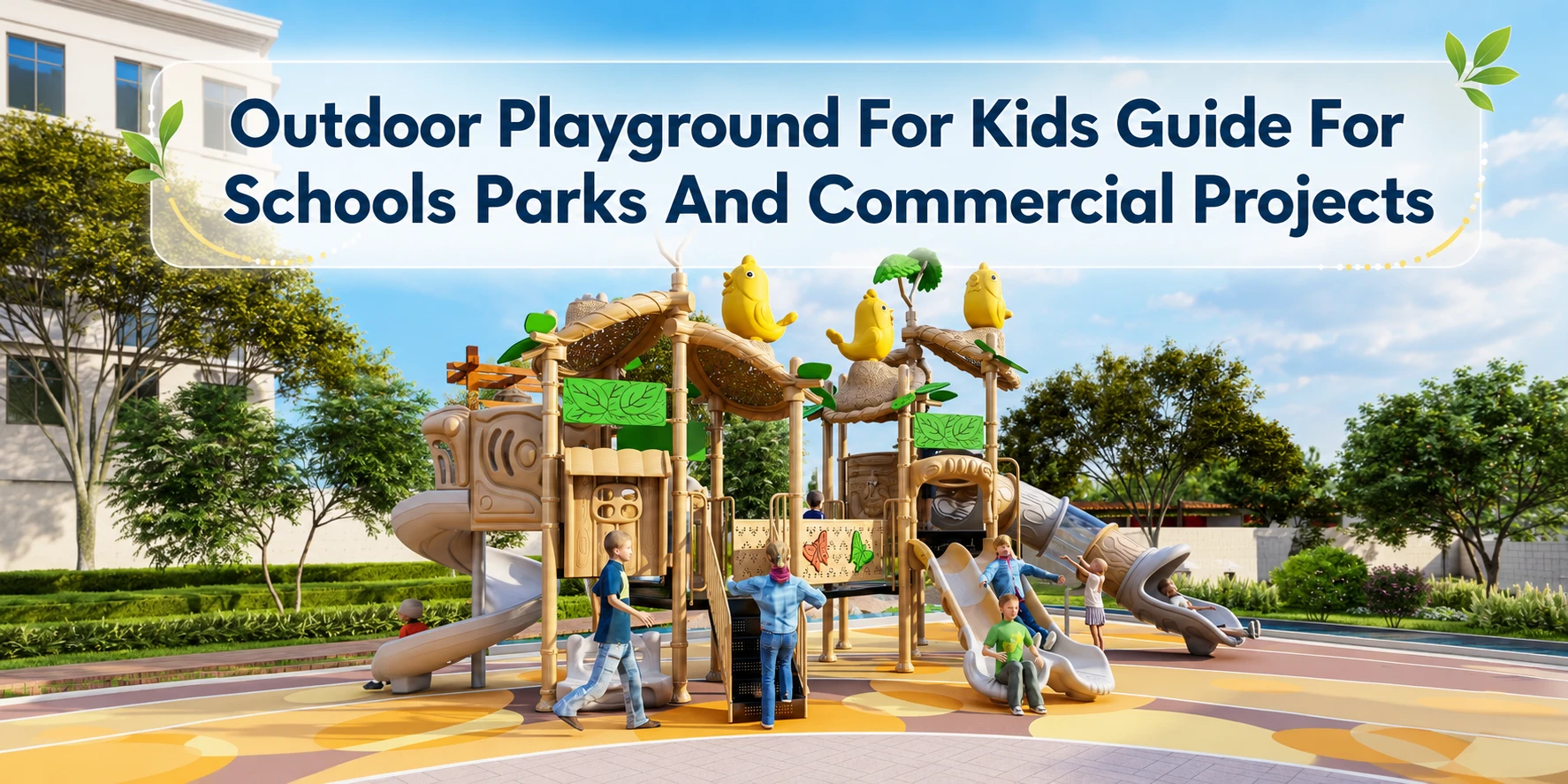
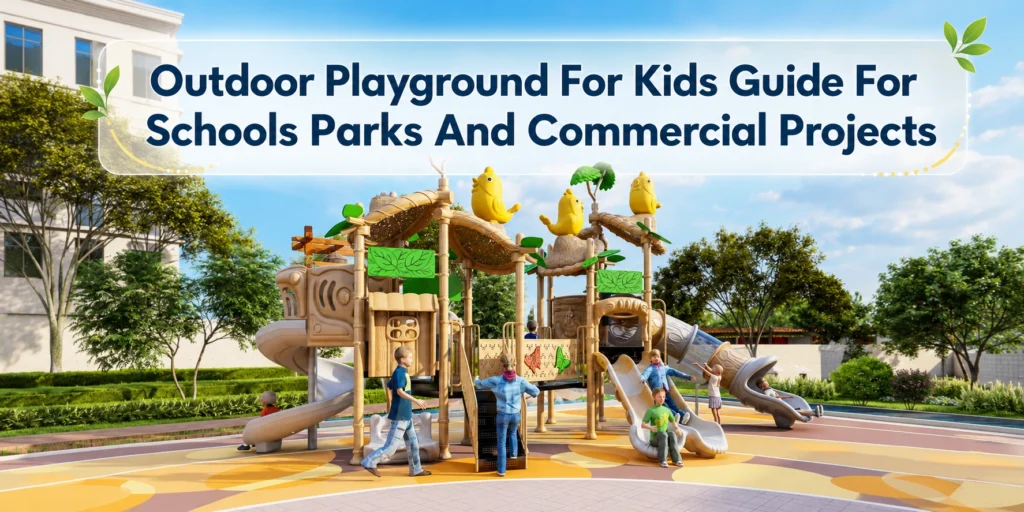
School buyers, kindergarten planners, and park operators face a common challenge: how to select a play system that meets safety regulations, fits a tight budget, and delivers lasting engagement for children aged 2–12. A single installation can see over 200 users daily, so structural quality and surfacing compliance are non-negotiable. When assessing a children playground supplier, you examine product range, certification documentation, and the ability to customise layouts.
An outdoor playground for kids is a purpose-built play environment designed for commercial settings — schools, nurseries, public parks, shopping centres, and community spaces. It comprises modular equipment such as swings, slides, climbing frames, and inclusive play panels engineered for heavy use and age-appropriate skill development.
This guide covers the main types of commercial playground systems, the safety standards you must verify, essential site preparation and installation steps, and the key cost factors that shape your project budget. For buyers seeking a reliable partner, JQ Playground (a children playground supplier founded in 1993) offers design, manufacturing, and export services for certified outdoor playground equipment.
Types of Outdoor Playground Systems for Commercial Spaces
Commercial playgrounds fall into four main categories, each suited to different age groups and site objectives. Knowing the distinction helps you match equipment to your space, budget, and safety requirements.
- Traditional swing-and-slide units – The most familiar format, typically built from galvanised steel with powder-coated finishes and rotationally moulded plastic slides. Suitable for ages 2–12, these systems suit parks and schoolyards where predictable play patterns are expected. A standard configuration might include two belt swings, a 2.5 m slide, and a small platform with a steering wheel.
- Modern climbing structures – Net climbers, boulder walls, and rope bridges challenge gross motor skills. Aimed at children aged 5–12, they require deeper fall zones (at least 1.8 m of impact-absorbing surfacing). These structures often use stainless steel cables and aluminium nodes for corrosion resistance in outdoor commercial settings.
- Themed playsets – Shipwrecks, castles, or jungle-themed units that combine slides, crawl tunnels, and interactive panels. Popular in shopping centres and family entertainment zones, they encourage longer dwell times. Themed panels are usually printed onto high-density polyethylene (HDPE) for UV stability.
- Fitness-oriented designs – Outdoor gym elements such as monkey bars, pull-up rings, and balance beams integrated into playground layouts. Increasingly specified by schools after research linked physical play to academic performance. Many suppliers now offer modular fitness add-ons that comply with EN 1176 standards.
When selecting a system, a reliable kids playground equipment supplier like JQ Playground can advise on load ratings and material warranties. If procuring for a school, your school playground supplier should provide age-zone segregation and fall-height calculations as standard.
Safety Standards and Age-Appropriate Design Essentials
Safety compliance starts with the correct standard: ASTM F1487 for US projects or EN1176 for European installations. Both specify impact attenuation, entrapment hazards, and structural integrity. JQ Playground manufactures outdoor playground equipment that meets EN1176, ASTM, CPC, and CPSIC standards, ensuring third-party certification is available before delivery.
Age-appropriate design prevents 70% of playground injuries, according to CPSC guidelines. Separate zones for toddlers (6–23 months), preschoolers (2–5 years), and school-age children (5–12 years) eliminate mismatched risk levels. Fall zones must extend a minimum of 1.8 m from any elevated platform over 600 mm.
Compliance checklist
- Certified surfacing depth: at least 300 mm loose-fill or compliant unitary rubber
- Guardrails 900 mm high on all platforms above 600 mm
- No gaps between 89 mm and 230 mm to prevent head entrapment
- Equipment spacing minimum 2.4 m between play structures
- Accessible route to at least 50% of activities (ADA / DDA standards)
| Age Group | Max Fall Height | Typical Equipment |
|---|---|---|
| Toddler (6–23 mo) | 0.6 m | Low platforms, sensory panels, ramps |
| Preschool (2–5 yr) | 1.5 m | Small slides, climbers, spring rockers |
| School-age (5–12 yr) | 2.4 m | Overhead ladders, large slides, multi‑axes spinners |
For a community playground supplier, specifying these height limits and zone layouts upfront avoids costly retrofit. Pair the standard with a fall‑height calculation sheet from your equipment vendor before ordering surfacing materials. JQ Playground offers free CAD-based design support to help you plan age-appropriate zones and certified layouts.
Essential Site Preparation and Installation Steps for Commercial Playgrounds
Begin with a geotechnical site assessment. Check soil type, drainage, and underground utilities before excavation. Soil preparation — levelling, compacting, removing debris — prevents settlement that creates trip hazards.
Next, decide on safety surfacing. Loose-fill (wood chips, rubber mulch) vs unitary rubber. Loose-fill needs a 200–300 mm depth per ASTM F1292 but settles over time. Unitary tiles or poured-in-place rubber cost more upfront yet require less topping up. For high-traffic sites like a mall kids playground supplier would serve, unitary rubber improves supervision and wheelchair access.
Layout planning should maximise sightlines for supervisors. Separate active and quiet zones. Mark fall zones around each elevated piece, and install a perimeter edge to contain loose-fill. Plan drainage away from play areas — standing water degrades both wood chips and rubber. Verify utility locations before pouring footings.
JQ Playground provides trial installation before shipping and can send engineers to your country for assembly assistance. This reduces on-site errors and speeds up project completion.
Budget Planning: Key Cost Factors for Outdoor Playground Projects
Your project budget splits into four main categories: play equipment, safety surfacing, installation labour, and ongoing upkeep. Equipment costs vary with size, complexity, and customisation. A basic modular unit with slides and platforms costs less than a bespoke climbing net structure with rope bridges and themed panels. Custom colour schemes or integrated shade canopies also add to the price.
Safety surfacing is often the second-largest line item. The material choice directly affects both initial outlay and replacement frequency.
| Surfacing Type | Relative Cost | Typical Longevity |
|---|---|---|
| Engineered wood fibre | Low to moderate | 2–4 years (topping up required) |
| Poured-in-place rubber | High | 10–15 years |
| Rubber tiles | Moderate to high | 8–12 years |
Loose-fill materials are cheaper upfront but need annual top-ups and full replacement sooner. Unitary surfaces like poured rubber cost more initially but reduce lifetime replacement cycles.
Installation labour depends on site conditions, equipment complexity, and local rates. Permit fees for commercial playgrounds vary by council but are generally a minor part of the total. Factor in ongoing maintenance — regular inspections, fastening checks, and surface replenishment — as a recurring operational cost.
For commercial buyers, the return on investment comes from increased footfall, longer dwell times, and higher user satisfaction. A well-maintained safe kids playground equipment package can justify its cost through repeat visits and positive community feedback. When sourcing, ask your kids outdoor playground supplier for a complete cost breakdown including surfacing options and maintenance schedules — not just the equipment price. JQ Playground offers free design support and a one-year quality warranty, helping you manage both initial and long-term costs.