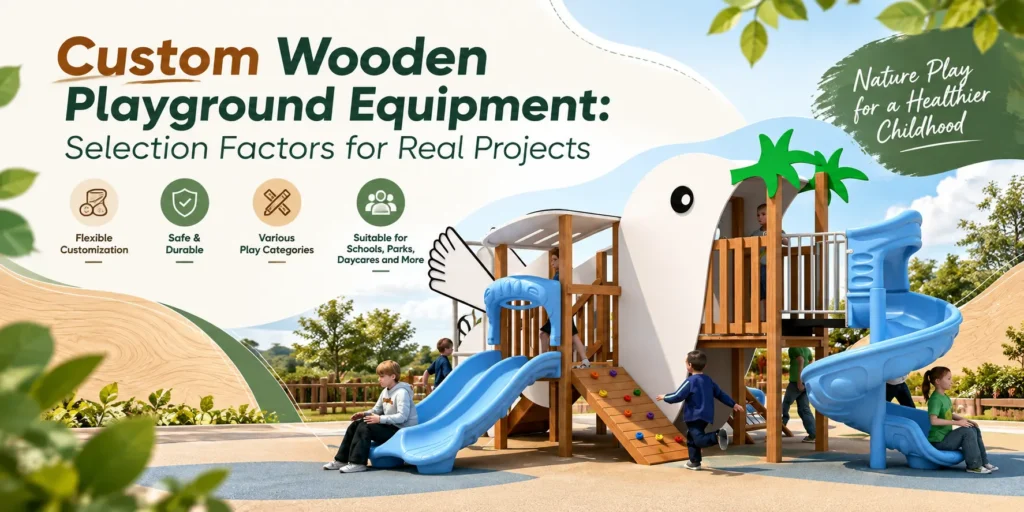
A school needs a tower under a boundary tree; a kindergarten wants low decks around a courtyard; a mall family zone must fit a climb unit beside a lift lobby. When the site sets the layout, catalogue playsets rarely fit. School, community, mall, park, distributor and contractor buyers need wood playgrounds built to measured space, age group and access.
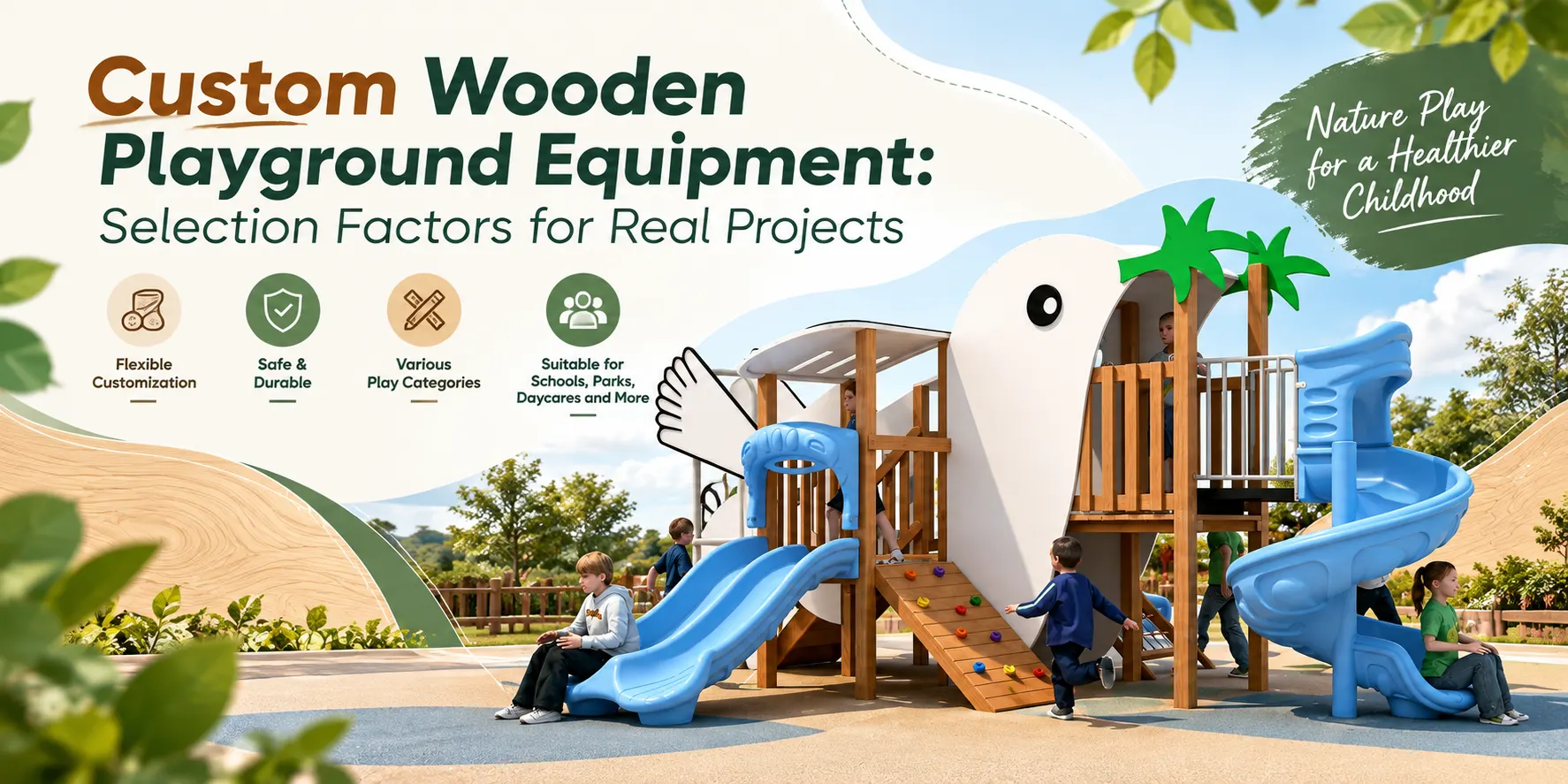
Custom wooden playground equipment refers to timber-based play structures configured to buyer-specified dimensions, components and finishes, supplied as a project package rather than a fixed catalogue item.
The sections below cover categories, specification, timber, package tiers and budget framing.
Wooden Playground Categories Built for Commercial and Institutional Sites
Search results for this keyword are mostly supplier product pages, so buyers meet wood playgrounds as category families rather than single SKUs. Four groups cover most enquiries.
- Tower-and-swing playsets: combined deck, roof and swing bay units. Common in kindergarten yards and park play areas, sold as a configured base rather than a loose kit.
- Modular swing frames and climbing units: frames and climbers bought now with capacity to add bays or panels later. Schools and community grounds use these where phasing is likely.
- Natural and themed wood structures: log clusters, balance posts, dome and pyramid forms from nature-play ranges. Parks and eco-focused school grounds specify them as standalone features.
- Freestanding add-ons: bridges, sandboxes and panel walls. Mall family zones and kindergartens use them to extend an existing footprint.
A kids playground equipment supplier will usually confirm which category your site plan matches before quoting.
How Does the Custom Design Process Work Once a Buyer Shares Site Details?
Once your site plan matches a category, the supplier converts it into a custom wooden playground equipment brief rather than a catalogue order. A typical workflow runs in four stages:
- Brief: Share the site plan, age band, capacity (for example, 40 children) and available footprint, including boundary and access constraints.
- Component selection: Choose decks, towers, slides, roofs, climb walls, swing bays and activity panels to fit the layout.
- Custom add-ons: Confirm themed panels, colour and finish choices, signage or shade.
- Pre-order planning: Review layout, surfacing and access with the supplier before sign-off.
Suppliers publish this as pre-order support, so expect drawings and a configuration summary, not a fixed catalogue number. Timber and panel durability are covered next.
Wood Species, Panels, and Treatment Choices for Outdoor Durability
Durability starts with matching each material to its load path and exposure. For custom wooden playground equipment, confirm treatment and maintenance before drawings are finalised.
Table 1: Material choices for custom wooden playground equipment
| Material | Where it is typically used | Maintenance or treatment point to confirm |
|---|---|---|
| Hardwood (Robinia) | Structural posts, towers, climbing frames | Knot and crack behaviour; re-oiling interval; splinter risk as it weathers |
| Pine or redwood | Decks, cladding, roofs | Moisture movement, resin bleed, re-oiling interval, surface checking |
| PE board or HDPE | Wall panels, activity surfaces | UV colour stability, moisture resistance, fixings, cleaning regime |
At enquiry, ask how the supplier applies treatment — pressure, brush or oil — and which safety standard the play equipment is assessed against. Request wording on fall height, entrapment and fixing corrosion rather than accepting a certification claim at face value.
Package Tiers and Modular Configurations Mapped to Venue Type
Package ranges labelled I to V, and grow-with-age modular playsets, usually step up by deck count, tower height, accessory quantity and add-on scope — not by timber grade. Confirm that before comparing quotes, because two packages in the same series can share identical post and panel specifications.
- Kindergarten yards: low deck heights, enclosed platforms, short slide runs and fence-line layouts that keep travel distances small. Ask for the lowest tier that still meets your capacity.
- School grounds: higher capacity, multiple swing bays and age-split zones. Expect mid-to-upper tiers, with swing bay count as the main cost lever.
- Community parks: larger footprints, mixed ages and themed wood structures, so specify separate zones per age band rather than one oversized unit.
- Mall family zones: compact modular units, low-noise components, themed panels and clear supervision sightlines from surrounding seating.
Map any safe kids playground equipment brief to a tier before you request drawings.
Budget, Build-or-Buy, and Value Considerations Before Enquiry
- Kit or configured package? A flat-pack kit limits you to the maker’s dimensions. A commissioned configuration fits your footprint and age band, so ask what the supplier adjusts — deck height, tower count, swing bays — before comparing prices.
- What drives project cost? Footprint and tower count set the timber volume. Accessory density adds hardware and labour. Surface works and site access for installation vehicles often move the figure more than the structure itself.
- Is custom worth it against a standard set? Where the site is fixed and the age group narrow, a standard set usually costs less. Custom pays back when boundaries, supervision sightlines or capacity rules out catalogue sizes.
Before requesting pricing, prepare site dimensions, age band and capacity, preferred wood or panel material, target package tier, and phasing plans. Suppliers and contractors can then quote comparable specifications rather than estimates you cannot line up side by side.
About JQ Playground – kidsplaygroundsupplier.com
JQ Playground (Wenzhou Jiqi Amusement Equipment Co., Ltd.) is a children’s playground equipment manufacturer founded in 1993. The company provides design, customization, large-scale manufacturing, sales, installation guidance, and after-sales support for outdoor playgrounds, indoor playgrounds, soft play, water playgrounds, PE board playgrounds, kindergarten furniture, outdoor fitness equipment, pet playgrounds, and playground facilities. Approved company facts include 180+ employees, a large Wenzhou production base, 20+ production lines, 55 production machines, ISO/BSCI/EN1176/EN71/ASTM/CPC/CPSIC certification references, 100+ patents, free design support, OEM/ODM capability, trial installation before shipping, export experience, and one-year quality warranty.