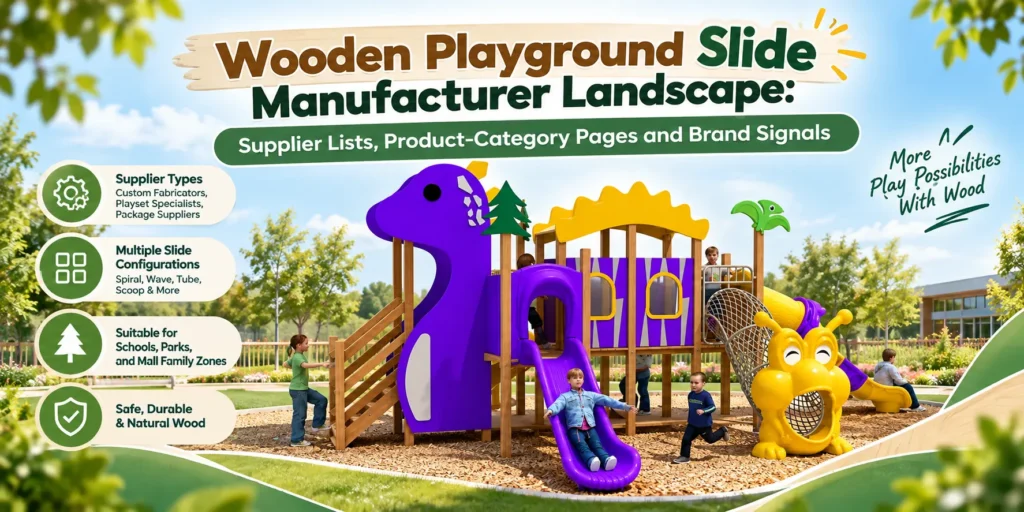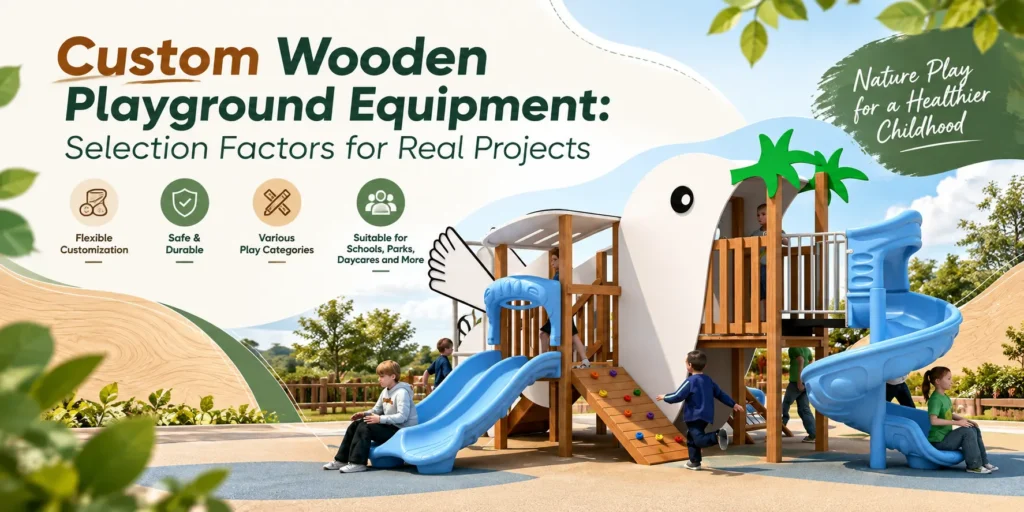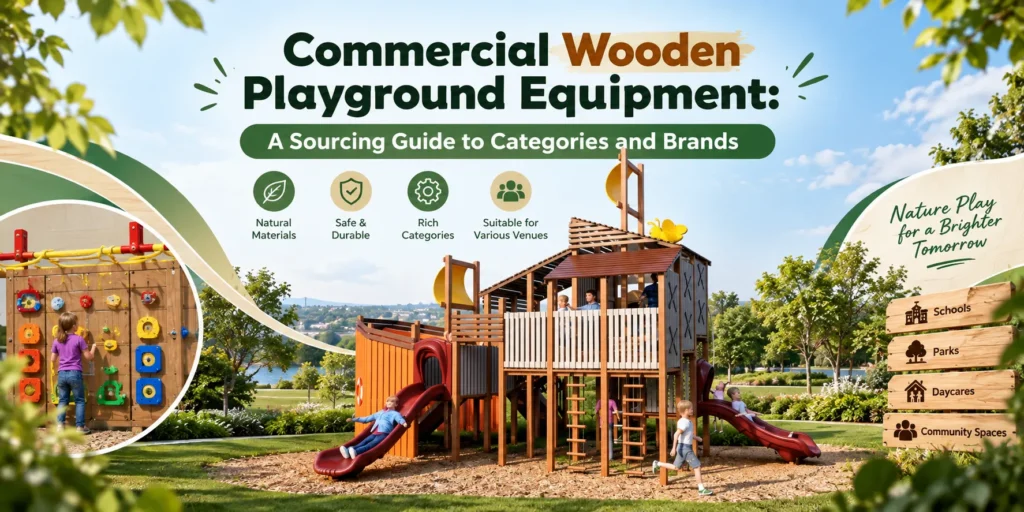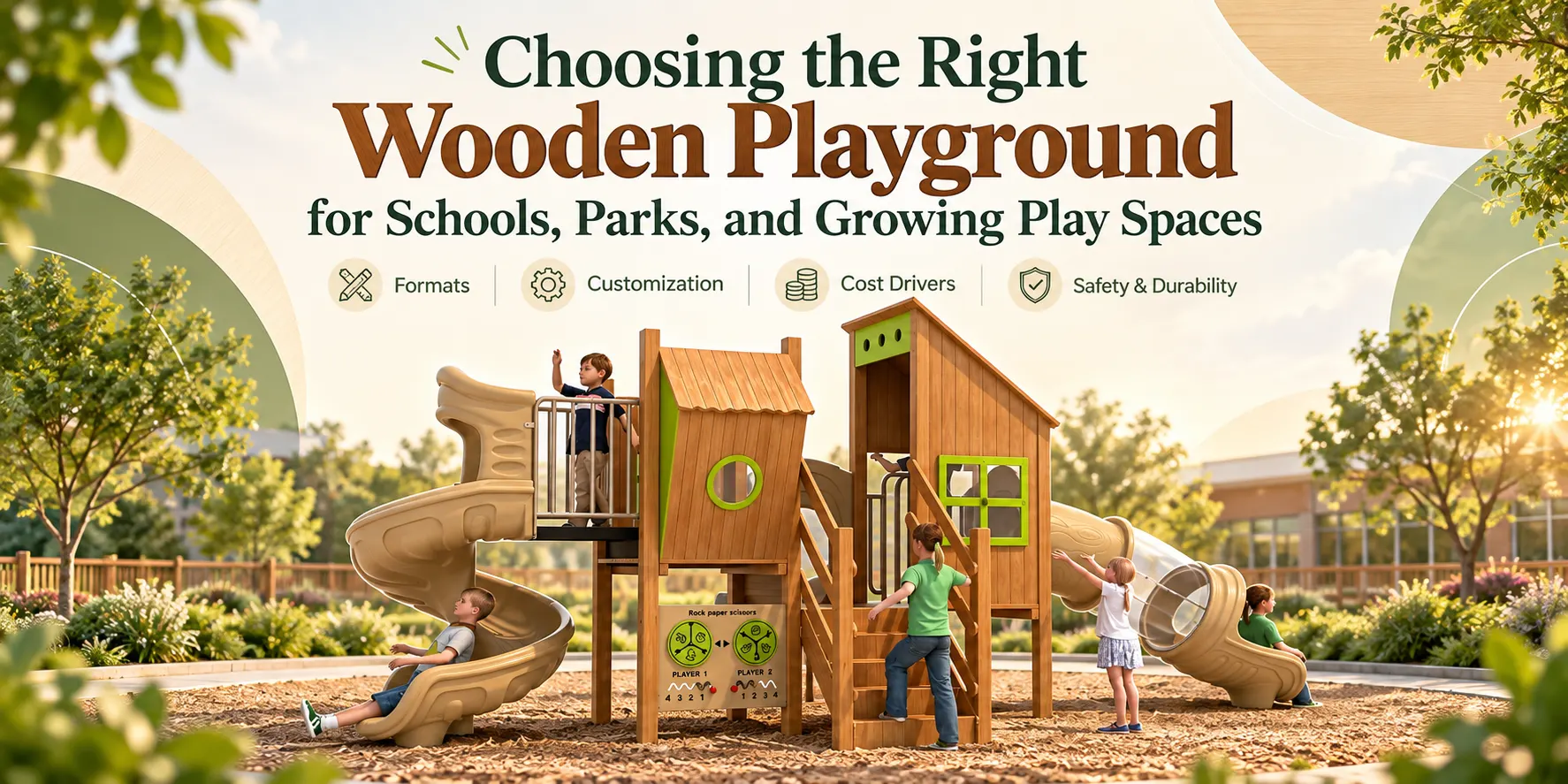
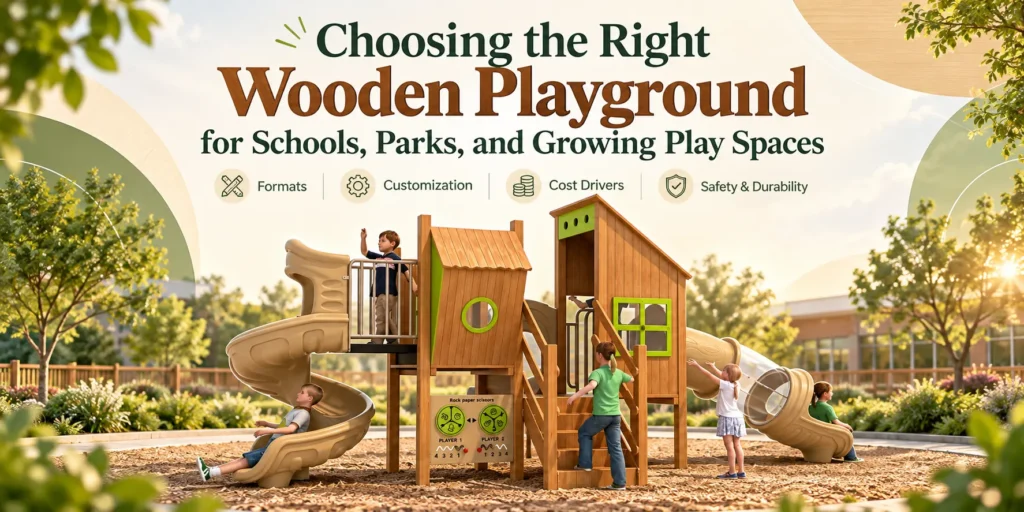
You are comparing quotes for a school yard or park. One document lists a swing set. Another describes a timber tower with decks, slides and climbing holds. Photos look similar, yet footprints, capacities and age ranges do not match.
A wooden playground is a play structure built from timber posts, decking and panels, usually combining swings, slides, climbing frames and platforms for children aged roughly two to twelve.
Comparing formats, customisation scope and cost drivers side by side keeps every quote comparable, and makes any brief to a children playground supplier clearer.
Wooden Playground Formats: Swing Sets, Playsets, and Modular Systems
Wooden playground formats fall into four broad groups, and each suits a different site. Product listings tend to sort them by footprint and age band rather than by timber type, so compare those two figures first.
- Custom swing sets — two to four bays, usually aimed at ages 3–12, for schoolyards, small parks, and larger gardens.
- Backyard playsets — compact towers with slides and climbing decks, sized around a single household.
- Indoor wooden play structures — lower platform heights and enclosed levels for kindergartens, malls, and family zones.
- Modular wooden systems — decks, bridges, and panels added in stages as capacity grows.
Match the format to the venue before pricing. A school playground supplier quoting a two-bay set and a kids playground equipment supplier quoting a modular layout are answering different briefs, so state footprint, age group, and user numbers in writing to keep every quotation comparable.
Custom Wooden Playground Designs for Schools, Parks, and Community Venues
Custom redwood playsets fit schools, parks and community venues because the timber is cut to suit the site instead of the site being cleared for a catalogue kit. Design-and-install services normally begin with a survey: boundary lines, fall zones, drainage, and whether a delivery lorry can reach the build area.
Modular wooden playground structures let you phase spend — open one bay this budget year, add climbing or slide modules the next. A community playground supplier should map expansion joints at quotation stage, so later additions do not force a rebuild.
Fix these variables in writing before pricing:
- Shape and footprint: linear run, L-shape, or tower cluster
- Age range: 2–5, 5–12, or separated zones
- Capacity: peak users per bay
- Site constraints: slopes, mature trees, buried services, drainage
Distributors should confirm load ratings and spare-part availability per module. Each wooden playground layout should state these points up front to keep quotations comparable.
Indoor and Outdoor Wooden Playground Applications for Kindergartens and Family Zones
Indoor and outdoor wooden playground projects split on four planning factors: footprint, weather exposure, supervision sightlines, and age grouping. Indoor sets suit early-learning rooms and mall family zones, where climate and entry points stay controlled. Outdoor playsets suit parks and schoolyards, where open ground and fall-zone clearance shape the layout.
| Factor | Indoor set | Outdoor playset |
|---|---|---|
| Space | Fixed footprint; check ceiling height | Larger footprint; clearance around swing runs |
| Weather | Climate control slows timber movement | Rain, UV and frost drive re-sealing |
| Supervision | Enclosed entry, easier ratios | Open edges, more staff coverage |
| Age grouping | Toddler and junior zones side by side | Separate swing bays for mixed ages |
When you brief a kids indoor playground supplier, confirm ceiling clearance, floor fixings, and how zones separate by age. Outdoor buyers should agree treatment cycles and inspection points before delivery. Placement settled here becomes the first cost input in any build-or-buy comparison.
Build vs. Buy: Cost Signals for Wooden Playground Packages
Buying a supplier package is usually cheaper than building from scratch once labour, tooling and site preparation are counted. Self-build wins mainly on one simple tower, where a retail kit and your own weekend cover the job.
| Cost factor | Self-build | Supplier package |
|---|---|---|
| Material | Retail unit prices, offcut waste | Bulk timber and fixings bundled |
| Design | You specify; errors surface on site | Drawings and cut lists supplied |
| Assembly | 20–40 crew hours per tower | Pre-drilled sections cut site hours |
| Site prep | You arrange levelling and surfacing | Often quoted with delivery and install |
| Scale and risk | Cost per tower stays flat; rework is yours | Per-unit cost falls; one party accountable |
Retail playset listings often quote structure only, so surfacing, footings, delivery and installation sit outside the headline figure. Ask a kids outdoor playground supplier to split structure, fixings, delivery, install and post-install checks. From three towers upward, package procurement usually lowers cost per child and limits rework.
Keep treatment class and inspection intervals beside the price line — durability drives whole-life cost on any wooden playground.
Safety, Durability, and Play Value in Wooden Playground Sourcing
Durability and play value are set long before delivery. Species comes first: robinia and cedar handle outdoor exposure with little chemical input, while pine and birch ply need pressure treatment and a re-coat every 12–24 months. Laminated beams resist warping better than solid posts.
Surface detail drives daily safety. Sanded arrises, countersunk fixings and sealed end grain cut splinter and moisture risk, and water-based finishes suit early-years settings. Check every opening for head and finger entrapment.
Play value tracks the age band: low platforms and ramps for under-3s, climbing nets and slides for 4–8s, loose parts for open-ended play. That mix keeps age appropriate playground equipment in use beyond the first term.
Procurement checklist for a wooden playground:
– Which timber species, and is end grain sealed?
– How often must finishes be reapplied?
– Are fixings concealed and tamper-resistant?
– Does deck height match the age band served?
– Can modules be added without re-anchoring?
Bring those answers to the package comparison.
About JQ Playground – kidsplaygroundsupplier.com
JQ Playground (Wenzhou Jiqi Amusement Equipment Co., Ltd.) is a children’s playground equipment manufacturer founded in 1993. The company provides design, customization, large-scale manufacturing, sales, installation guidance, and after-sales support for outdoor playgrounds, indoor playgrounds, soft play, water playgrounds, PE board playgrounds, kindergarten furniture, outdoor fitness equipment, pet playgrounds, and playground facilities. Approved company facts include 180+ employees, a large Wenzhou production base, 20+ production lines, 55 production machines, ISO/BSCI/EN1176/EN71/ASTM/CPC/CPSIC certification references, 100+ patents, free design support, OEM/ODM capability, trial installation before shipping, export experience, and one-year quality warranty.