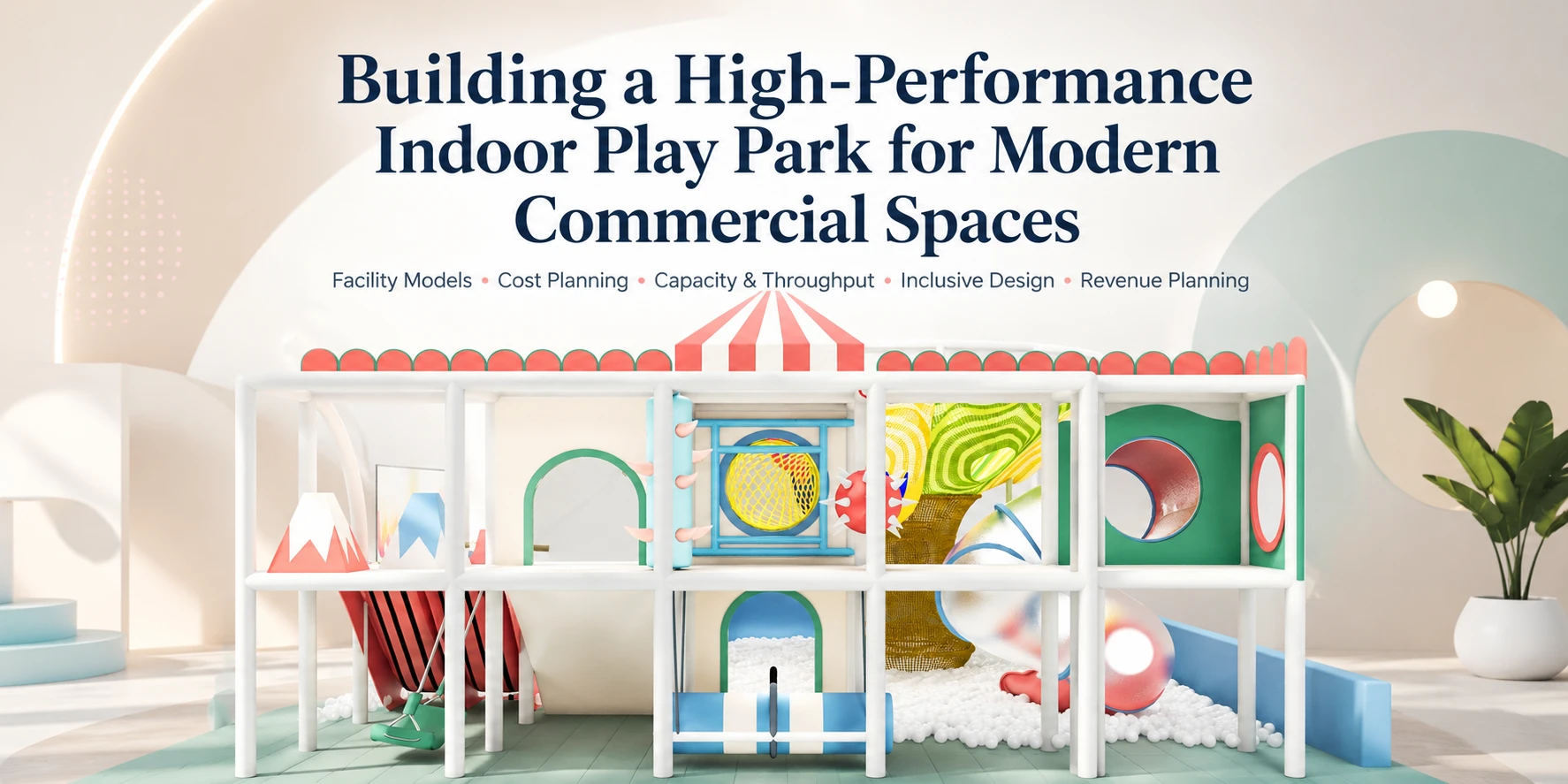
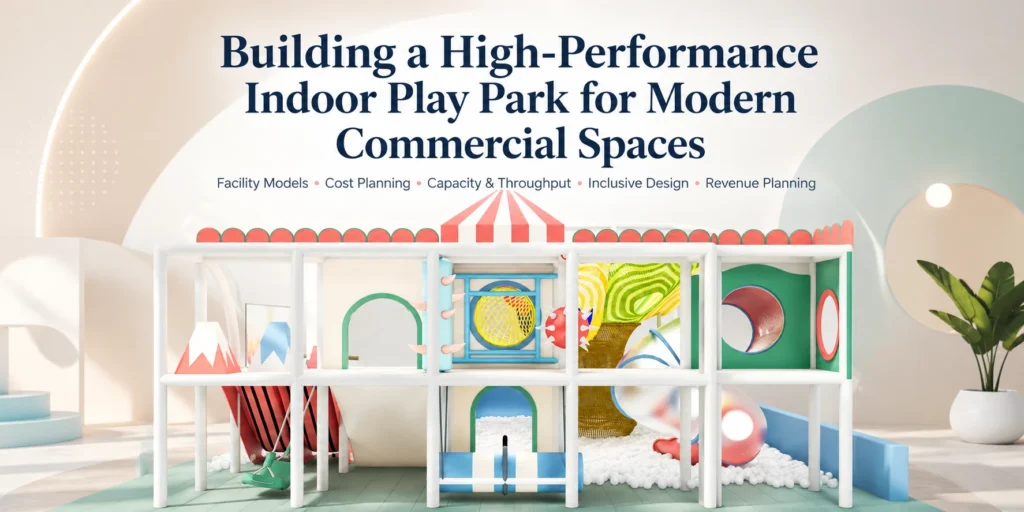
An indoor play park is a commercial indoor play space where children climb, slide and explore on purpose-built structures. You might be a school buyer, park owner, mall family-zone team or community operator weighing play value against safety, footfall and revenue. Contractors and distributors face the same question in reverse: what equipment will perform? Sourcing demands clear thinking on facility models, cost, size, inclusive design and revenue streams before approaching a kids playground supplier.
Indoor Play Park Facility Types and Operator Models
Each indoor play park model places different demands on equipment. Standalone family entertainment centres, such as Complete Playground, operate as non-profit inclusive spaces; their buyers prioritise accessible, durable multi-level structures and sensory-friendly zones over arcade revenue. Party-focused venues like Flying Apple lean the other way, with party rooms, tables and themed soft play layouts driving per-head spend; the buying team typically wants modular zones that convert between open play and event hire.
Community centre play areas and mall soft play zones need compact footprints. Schools and community operators source smaller freestanding units with clear sightlines for supervision, while mall teams favour modular soft play that fits tight floor plans and handles continuous footfall. When approaching a school playground supplier, specify the operator model first — it determines safety certification, maintenance schedules and, ultimately, your budget.
Indoor Play Park Cost Drivers and Pricing Models
Admission pricing for an indoor play park hinges on the equipment you install. Public venue data shows The Kids Town charges roughly $12 per child for daytime entry, while Flying Apple bundles admission into party packages of $300-$500. Across SERP-listed venues, typical per-child admission sits at $10-$20 and party packages at $300-$500.
Your main cost drivers:
- Equipment type — soft play units cost less than multi-level structures or climbing walls
- Square footage — larger floor plans raise equipment, flooring and surfacing costs
- Customisation — themed or branded structures add 15-30% over standard units
- Installation — site prep, safety matting and structural rigging
- Insurance and staffing — supervision ratios and liability cover
When reviewing quotes from a kindergarten playground supplier or community playground supplier, request line-item pricing for each driver. Membership models smooth cash flow but demand enough daily visitors to cover fixed staff costs. Your capacity target ultimately decides which equipment type and footprint make sense.
Indoor Play Park Size and Capacity Benchmarks for High-Traffic Venues
Capacity planning for an indoor play park starts with square footage per child. Use 10-15 sq ft of active play area per child as a working benchmark, then add circulation space for parents, buggies, and seating. Oversized venues draw bigger crowds, but they also demand more supervision zones and restroom capacity.
Size categories:
– Small soft play zones: 1,000-3,000 sq ft — mall family zones, community centre corners, and preschools.
– Mid-size parks: 5,000-10,000 sq ft — party-focused venues and standalone town operations.
– Large venues: 15,000+ sq ft — full family entertainment centres; Complete Playground claims the largest indoor playground in NYC at this scale.
Mall family zones usually need compact footprints to fit tenant shells, so a mall kids playground supplier must offer modular layouts for tight spaces, while standalone parks can spread further. Yelp’s top 10 NYC listings confirm most high-traffic venues sit in the mid-to-large band. Check local occupancy limits before finalising your layout; they often cap total children regardless of play equipment, and your footprint choice determines which access routes and zones you can fit.
Inclusive and Sensory-Friendly Indoor Play Park Design Essentials
An inclusive indoor play park serves neurotypical and neurodivergent children side by side, so accessibility must shape the layout from the first sketch. Ramps and wider pathways let wheelchair users reach every level, while quiet rooms give overstimulated children a calm retreat.
Equipment features to source:
– Fibre-optic strands and bubble tubes for low-stimulation visual play
– Tactile panels with varied textures for hands-on exploration
– Weighted swings that deliver deep-pressure proprioceptive input
Design considerations:
– Symbol-based signage with high colour contrast
– Flooring with reduced glare and acoustic dampening
– Gradual transitions between busy and calm zones
Follow ADA dimensions for ramps, door widths and reach ranges, and apply inclusive principles such as multiple play types at each height. Ask suppliers for inclusive design documentation, including accessibility drawings and sensory specifications, before you commit. An accessible park widens your visitor base, which directly supports the party and arcade revenue planning that follows.
Those extra visitors convert directly into bookable revenue. Party packages drive the highest per-head spend: Flying Apple-style venues charge $300-$500 per party, versus $10-$20 walk-in admission, so the same floor space earns several times more per booking. Fit birthday rooms with child-height tables, stackable chairs, partition walls and an audio system. Add arcade machines, redemption counters and prize dispensers to extend dwell time, plus a food service counter for meal sales.
Checklist when sourcing package deals:
- Party room kit: tables, chairs, partitions, audio system
- Arcade and redemption: machines, prize dispensers, token counters
- Food service: counter, storage, serving equipment
- Supplier terms: layout drawings, installation, spare parts, and age appropriate playground equipment documentation for younger siblings in party zones
About JQ Playground – kidsplaygroundsupplier.com
JQ Playground (Wenzhou Jiqi Amusement Equipment Co., Ltd.) is a children’s playground equipment manufacturer founded in 1993. The company provides design, customization, large-scale manufacturing, sales, installation guidance, and after-sales support for outdoor playgrounds, indoor playgrounds, soft play, water playgrounds, PE board playgrounds, kindergarten furniture, outdoor fitness equipment, pet playgrounds, and playground facilities. Approved company facts include 180+ employees, a large Wenzhou production base, 20+ production lines, 55 production machines, ISO/BSCI/EN1176/EN71/ASTM/CPC/CPSIC certification references, 100+ patents, free design support, OEM/ODM capability, trial installation before shipping, export experience, and one-year quality warranty.