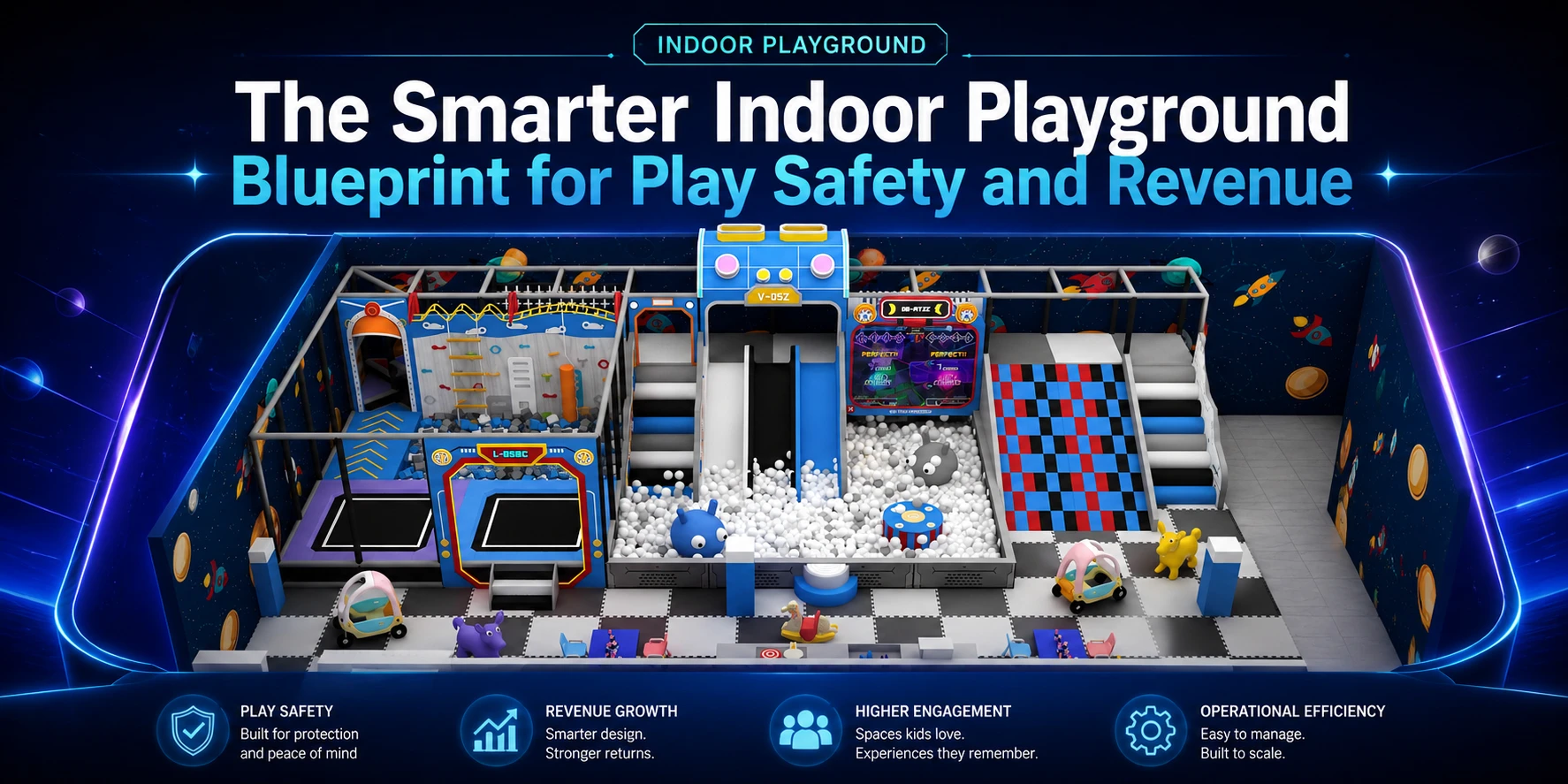
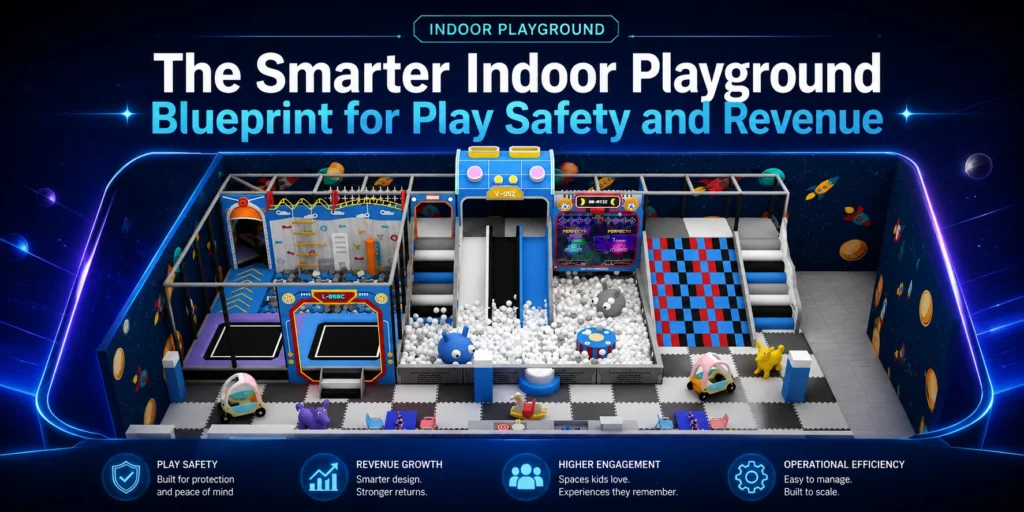
Basic soft play no longer fills a weekend calendar. Venue operators are expanding their offer to pull in school groups, birthday parties, and repeat family visits, and that shifts how you plan, budget, and source equipment.
An indoor playground is a climate-controlled, safety-surfaced play space with soft play structures, slides, climbing elements, and often themed zones, designed for children in a defined age range.
This article covers facility layout, attractions, safety, and revenue models to guide your procurement.
Venue Configurations and Age-Specific Zones in Today’s Indoor Playgrounds
Typical floor areas run from 5,000 sq ft for neighbourhood soft play to 20,000+ sq ft for full family entertainment centres. Match your square footage to your catchment demographics, not the reverse.
Ready Set Play serves ages 2–12 across multi-level play; Busy Bees focuses on toddler zones with lower platforms and gentler slopes. Kidsports pairs its playground with laser tag and bowling for older children. Before specifying equipment, map zones to your expected ages:
- 0–2 years: floor-level pads, foam shapes, and crawl tunnels, separated from active traffic
- 2–4 years: low-platform soft play, ball pools, and gentle wave slides
- 5–8 years: multi-level tube mazes, slides, and climbing walls
- 9–12 years: obstacle courses, sports courts, and arcade or laser-tag space
A community centre serving parents of toddlers needs more 0–4 space; a mall site chasing birthday parties may prioritise the 5–8 zone. With zone sizes fixed, the next step is choosing the attractions that fill them.
Attractions That Define an Indoor Playground: Slides, Tubes, Soft Play, and More
The equipment mix determines floor plan, budget, and repeat visits. These are the zones buyers specify most often:
- Multi-level soft play: ages 2–8; 1,500–3,000 sq ft; highest play value per square metre because children self-direct between levels.
- Tube mazes: ages 3–10; from 500 sq ft; link slides and ball pools to extend dwell time.
- Slides (straight, wave, spiral): ages 2–12; straight suits toddlers, wave and spiral reward older kids; check clearance height for the tallest unit.
- Ball pools: ages 1–6; 200–600 sq ft; strong sensory appeal but demand daily cleaning.
- Climbing walls and obstacle courses: ages 5–12; 800+ sq ft with safety matting; drive party bookings.
- Arcade and sports zones: adding basketball or laser tag captures older siblings and lengthens visits.
Procurement choices affect maintenance. Modular structures let you swap zones; custom builds fit awkward spaces but limit reconfiguration. Specify high-density foam (25–30 kg/m³) and finishes that tolerate commercial sanitisers.
Safety and Inclusive Design for Indoor Playground Procurement
Put safety compliance and inclusive access on the same tender checklist. Buyers who separate the two pay for retrofits later. Ask any mall kids playground supplier to demonstrate both in writing.
- Validate the standard. Specify EN 1176 for European projects or ASTM F1918 for North American sites, and request the test report.
- Choose flooring by zone. Rubber tiles or poured rubber suit slide exits; foam-backed vinyl suits toddler areas. Pad thickness must match critical fall height.
- Inspect edge geometry. EN 1176 requires exposed corners and edges rounded to a minimum 3 mm radius. Also check pinch points and gaps.
- Design supervision sightlines. Keep structures below staff eye level or add convex mirrors so every zone is visible from the entry desk.
- Set a documented cleaning schedule. Choose non-porous, wipe-clean flooring and request sanitiser compatibility guidance from the manufacturer.
- Plan quiet zones. Add a dim-lit, low-noise area and offer sensory-friendly hours for neurodivergent children.
Beyond Open Play: Arcade, Cafe, and Party Revenue for Indoor Playground Operators
Day passes alone rarely cover rent, staffing, and insurance. Operators layer memberships, parties, arcade credits, and cafe sales to lift spend per visit.
SERP evidence points to three proven models. ‘Regulars save the most’ memberships turn frequent visitors into predictable income (e.g. £45/month for unlimited off-peak play). ‘Un-bee-lievable birthdays’ bundle a party room, cake, and host at a fixed per-child rate. ‘Book Indoor Playground Sessions with Extra Activities’ upsells arcade credits or sports courts onto standard admission.
For contractors, these add-ons change the build. Allocate 15–20% of floor area to party rooms and cafe seating. Budget 32A power for arcade cabinets, plus a water supply and floor drain for the cafe. Staffing rises by one attendant per 20 children during party blocks.
Revenue bundles that work:
– Membership + cafe loyalty card
– Party package + arcade credit top-up
– Day pass + sensory-hour add-on
About JQ Playground – kidsplaygroundsupplier.com
JQ Playground (Wenzhou Jiqi Amusement Equipment Co., Ltd.) is a children’s playground equipment manufacturer founded in 1993. The company provides design, customization, large-scale manufacturing, sales, installation guidance, and after-sales support for outdoor playgrounds, indoor playgrounds, soft play, water playgrounds, PE board playgrounds, kindergarten furniture, outdoor fitness equipment, pet playgrounds, and playground facilities. Approved company facts include 180+ employees, a large Wenzhou production base, 20+ production lines, 55 production machines, ISO/BSCI/EN1176/EN71/ASTM/CPC/CPSIC certification references, 100+ patents, free design support, OEM/ODM capability, trial installation before shipping, export experience, and one-year quality warranty.